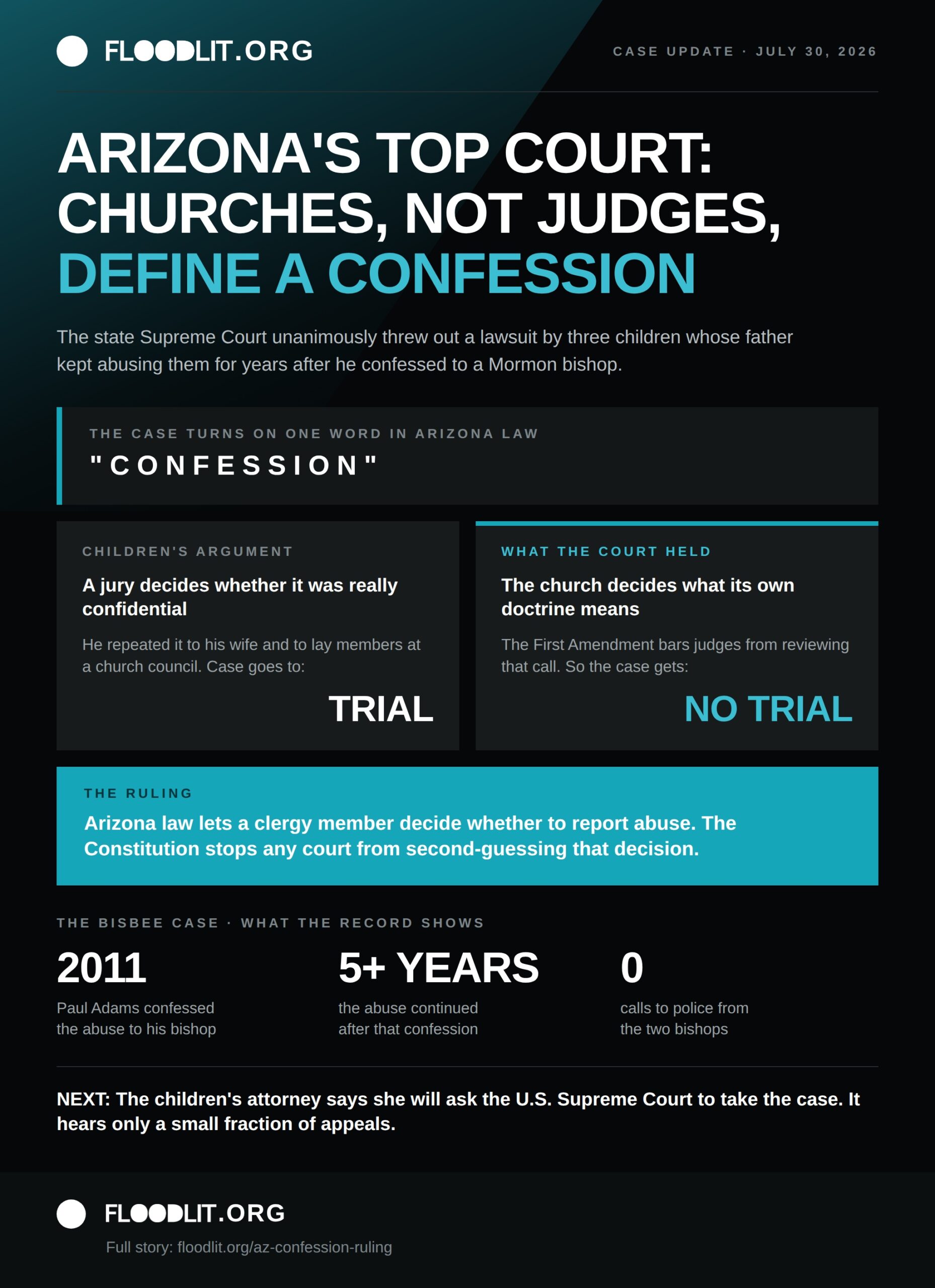
The Arizona Supreme Court ruled unanimously Thursday that a Mormon bishop had no legal duty to tell police about a father’s confession of child sexual abuse – and that judges and juries may not second-guess how a church reads its own doctrine. The abuse continued for more than five years after that confession.
PHOENIX – The Arizona Supreme Court on July 30 ended a lawsuit brought by three children of Paul Adams, a Bisbee man who sexually abused his own children for years after telling a leader of The Church of Jesus Christ of Latter-day Saints (Mormon church) what he was doing.
The court did not rule on whether the church behaved decently. It ruled on something narrower and, for future cases, far more powerful: who gets to decide what a “confession” is. The answer was the church.
Vice Chief Justice John R. Lopez IV, writing for a unanimous court, put it plainly: “We may not substitute our interpretation of Church doctrine for the Church’s reading of its own doctrine.”
The decision reinstates a 2023 trial court judgment for the church and wipes out a 2025 appeals court ruling that had put the case back on track for a jury.
The rules, in plain terms
Readers outside the United States may need three pieces of background before the ruling makes sense.
Mandatory reporting. Arizona law – section 13-3620 of the state’s criminal code – requires any person who reasonably believes a child is being abused to report it, and requires certain categories of people, including doctors, teachers, police officers, parents and clergy, to report immediately by telephone or in person. Failing to do so is a crime.
The clergy exemption. The same statute carves out an exception. A member of the clergy who receives a confidential communication or confession “may withhold reporting of the communication or confession if the member of the clergy … determines that it is reasonable and necessary within the concepts of the religion.” Note the wording: the clergy member makes the call. The exemption covers only what was said in confidence, not what the clergy member personally observed. Most US states have some form of this exemption.
The First Amendment. The first article added to the US Constitution bars the government – courts included – from establishing religion or interfering with its free exercise. American courts have long read this to mean they cannot referee internal theological disputes. A judge may not rule that a church is wrong about its own beliefs.
Those three pieces are the whole case.
What happened in Bisbee
Paul Adams was a mission support specialist with the US Border Patrol, living in Bisbee, a small town near the Mexican border.
In November 2011, Adams told his bishop, John Herrod, that he had been sexually abusing his eldest daughter, who was then five years old. Herrod called an internal church “abuse help line.”
The Associated Press reported in 2022 that the line is staffed by social workers and counselors who destroy the day’s call notes each night, with sensitive calls routed to lawyers at Kirton McConkie, the church’s Salt Lake City law firm.
Herrod has said the guidance he got back was blunt: “They said, ‘You absolutely can do nothing.'”
Herrod did not call police. He brought Adams’s wife, Leizza, into the conversation, counseled the couple, and suggested one of them report it themselves. Neither did.
In 2013, a second bishop, Robert “Kim” Mauzy, convened a church disciplinary council – an internal tribunal, staffed partly by lay members of the congregation, that can expel someone from the faith. Adams was excommunicated. Police were still not called.
The abuse did not stop. Adams went on abusing his eldest daughter and began abusing an infant daughter as well. He filmed it and distributed the footage online.
Police in New Zealand recovered one of the videos in 2016, and investigators traced it back to Arizona. Adams was arrested in February 2017 – more than five years after the confession – and died by suicide in custody that December, before he could be tried.
Leizza Adams pleaded no contest to two felony counts of child abuse and was sentenced to two and a half years in prison.
Why the appeals court had ruled the other way
Three of the children sued the church and the two bishops, arguing the church had a duty to report and instead helped bury the case.
In November 2023, Cochise County Superior Court Judge Timothy Dickerson ruled for the church without letting the case reach a jury, relying on the clergy exemption.
On July 29, 2025 – almost exactly a year before this week’s decision – the Arizona Court of Appeals reversed him and sent the case back for trial. Its reasoning was practical rather than theological: Adams’s statements did not look confidential. He had repeated them in front of his wife. Lay members of the congregation heard the details during the 2013 disciplinary council. And Adams had distributed video of the abuse himself.
If the communications were not actually secret, the appeals court reasoned, an exemption written for secret communications should not apply – and a jury could sort out the facts.
The Supreme Court’s answer
The Supreme Court’s response was that the question was never a factual one for a jury.
Whether a statement counts as a “confession,” and whether keeping it confidential is “reasonable and necessary within the concepts of the religion,” are questions of religious doctrine. The First Amendment, the court held, generally prohibits fact finders from inquiring into a clergy member’s application of his own religious doctrine.
“[T]he Reporting Statute and bedrock First Amendment principles compel our decision in favor of the Church Defendants,” the court wrote.
One distinction gets blurred in a lot of coverage of this case and is worth spelling out. The clergy-penitent privilege – the rule that a priest cannot be forced to testify in court about a confession – is a rule about evidence. It is not, by itself, what excused Herrod from calling police. That came from the reporting statute, which hands the judgment call to the clergy member.
Read together, those two elements are what makes the ruling sweeping. The statute lets the clergy member decide. The Constitution stops anyone from reviewing that decision.
Who lined up behind the church
The church did not argue alone. Friend-of-the-court briefs supporting its position came from the Catholic dioceses of Phoenix, Tucson and Gallup, the Church of Scientology International, the General Conference of Seventh-day Adventists, the African Methodist Episcopal Church, BAPS Swaminarayan Sanstha, the Jewish Coalition for Religious Liberty, the American Islamic Congress and the Becket Fund for Religious Liberty, among others.
Reaction
Lynne Cadigan, the Tucson attorney for the children, was scathing: “This gives all religions absolute immunity to keep child abuse secret. This makes Arizona a very dangerous state for children.”
She said she intends to ask the US Supreme Court to review the decision. That court hears only a small fraction of the cases submitted to it.
Angela Walker, executive director of the Survivors Network of those Abused by Priests (SNAP), described the outcome as a confessional loophole that lets predators avoid consequences, and said child safety should outrank church procedure.
Doug Andersen, a spokesman for the Mormon church, called the abuse “reprehensible” and said Arizona law recognizes the confidentiality of confession. The decision, he said, affirms that “these religious protections are to be respected alongside society’s shared commitment to protect the vulnerable.”
What this changes
The case is over in Arizona. Absent US Supreme Court intervention, the Adams children have no path to a jury.
It is binding precedent. Every Arizona court must now follow it. A religious institution’s own account of its doctrine controls, and that account is not something a jury weighs.
It casts doubt on legislative reform. This last point is analysis rather than holding, but it follows from the opinion’s logic. Several states have moved in recent years to strip or narrow the clergy exemption. An Arizona bill doing the same would face a serious constitutional challenge, because the obstacle the court identified is not the exemption’s wording – it is the impossibility of a court reviewing a clergy member’s religious judgment at all.
The case is Jane Doe I, Jane Doe II, and John Doe v. The Corporation of the President of The Church of Jesus Christ of Latter-day Saints, et al., No. CV-25-0213 (Ariz. July 30, 2026).
FLOODLIT.org is an independent newsroom that investigates sexual abuse in The Church of Jesus Christ of Latter-day Saints. Read our full Paul Douglas Adams case report and our report on Leizza Adams’s child abuse conviction.
FLOODLIT.org is 100% reader supported and we depend on your donations to be able to get court documents and provide original research and reporting. Our database contains over 4,200 case reports related to sexual abuse and sex crimes allegedly perpetrated by active members or leaders in the Mormon church.