Key takeaways:
- On Sept. 8, 2026, U.S. District Judge Michael J. McShane ruled that Oregon negligence law imposed no legal duty on The Church of Jesus Christ of Latter-day Saints to protect a 15-year-old girl from her adoptive father, who was later convicted of raping her.
- The lawsuit alleges church leaders were told again and again: a stake president in April 2016, the girl’s mother’s bishop in December 2016, the church’s confidential records office in Salt Lake City, and her new bishop in Oregon in February 2017. According to the lawsuit, no one called police.
- The girl lived alone with her abuser in Albany, Oregon, for almost two years. Her lawyers say he abused her at times more than once a day.
- In court, the church’s lawyers wrote that Craig Ford “commenced a sexual relationship” with the 15-year-old and “began having sex with her.” Church records allegedly called the abuse “consensual.”
- The judge called the alleged inaction “objectionable” and the church’s abuse policies “disappointingly hollow.” Then he ruled for the church anyway.
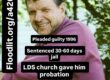
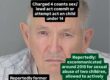
- Craig McNeil Ford was convicted three times between 2018 and 2022, twice for the rape and incest of the girl who sued.
BREAKING: FLOODLIT.org has learned that on Sept. 8, 2026, a federal judge in Eugene, Oregon, ruled against a woman who accused The Church of Jesus Christ of Latter-day Saints of doing nothing after her adoptive mother told a church leader she suspected her husband was sexually involved with the then-15-year-old girl.
The judge held that Oregon negligence law did not require the church to protect her.
That’s despite the fact that her adoptive father, Craig McNeil Ford, was later convicted of raping her.
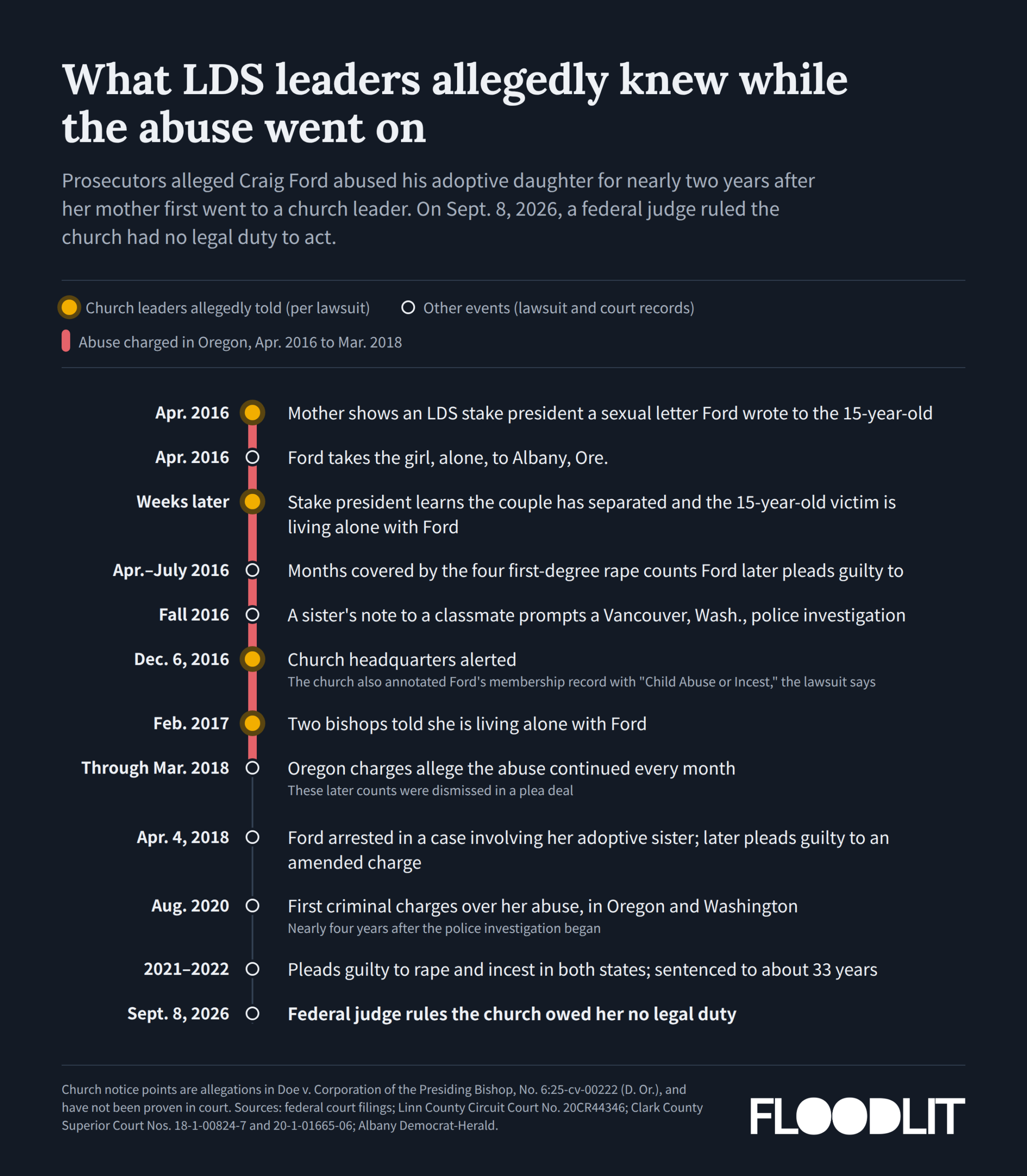
The lawsuit alleges that the girl’s mother showed an LDS stake president a sexual letter Ford wrote to the girl.
Weeks later, the lawsuit says, Ford took the girl alone to Oregon, where he raped her almost daily.
Eight months after that, the mother told her bishop the abuse was still happening, according to the lawsuit. Church headquarters was alerted and allegedly annotated Ford’s membership record to note he had been involved in “Child Abuse or Incest.”
The lawsuit says the church still did not report him, investigate, or intervene.
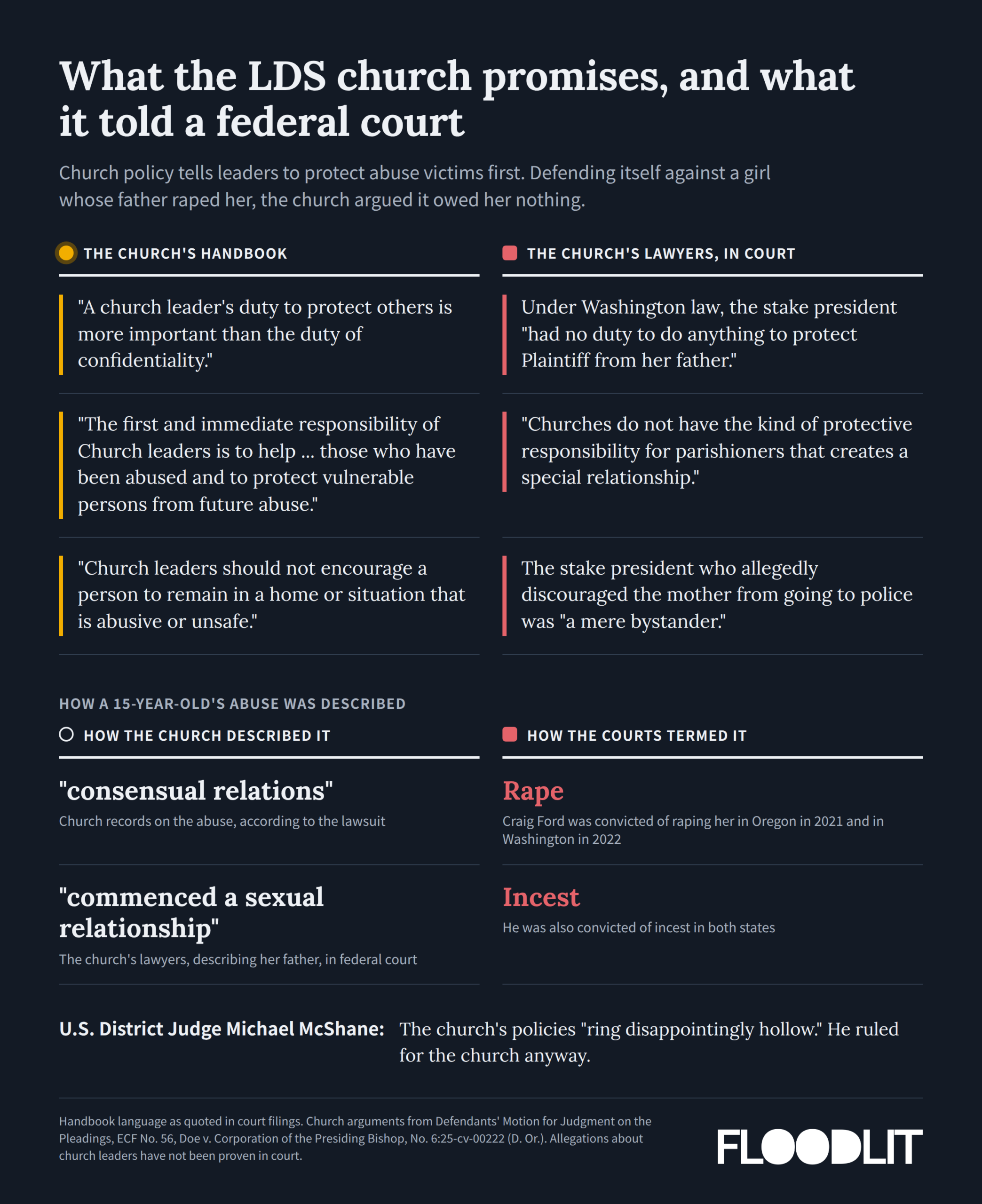
The church told the court it never had to. Its lawyers wrote that under Washington law, the stake president “had no duty to do anything to protect Plaintiff from her father.”
McShane called the alleged inaction “objectionable.” He called the church’s abuse policies “disappointingly hollow.”
Then he granted the church judgment on the pleadings.
What the lawsuit alleges
An LDS stake president was shown a sexual letter a 31-year-old man wrote to his 15-year-old adoptive daughter, according to the lawsuit.
The girl’s mother told the church leader she suspected the two were in a sexual relationship.
The man had admitted to his wife that he bought the girl a sex toy, the complaint says.
Within weeks, the lawsuit says, Craig Ford picked up the girl from relatives in Montana and took her alone to Albany, Oregon.
In court filings, she is identified as Julie Doe.
The church leader, Wade Pickett, learned that Ford’s marriage had broken down and that Ford was living alone with Julie, the lawsuit says.
According to the lawsuit, Ford kept sexually abusing her for almost two years.
Ford was later convicted in both Oregon and Washington of incest and rape involving Julie.
Yet McShane ruled that the church had no legal duty under Oregon negligence law to protect Julie from abuse that happened in Ford’s home.
In the same order, McShane let Julie file an amended complaint with new allegations, many of them drawn from church records turned over in discovery.
He then ruled that even the expanded allegations did not establish a duty.
The case is Doe v. Corporation of the Presiding Bishop of the Church of Jesus Christ of Latter-day Saints et al., No. 6:25-cv-00222-MC (D. Or.).
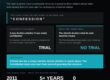
Craig Ford lawsuit – LDS church timeline
Who is Julie Doe?
Julie came to the Fords through the foster care system.
The State of Washington placed her with Craig and Jennifer Ford in 2013, when she was 12, according to court filings. The Fords adopted her the following year.
She was baptized into the LDS church in October 2014. The next year, the Fords adopted another girl, identified in court papers as Sheila Doe.
The family attended a ward in Clark County, Washington, where Craig Ford became an elder and Julie regularly took part in church activities.
In December 2015, when Julie was 15, Craig Ford began sexually abusing her, the lawsuit says. He was 31.
Julie did not understand what was happening to her as abuse.
According to her lawyers, she believed Ford’s sexual contact was a sign of affection and love. She thought she was a willing participant.
Her lawyers argue the church helped keep her believing that.
If church leaders had treated her as a victim, as their own handbook directs, she would have known she was one, the filings argue. Instead, she kept living with her abuser and did not tell authorities.
Julie is now an adult. She sued in February 2025 under a pseudonym.
The judge’s opinion opens by calling her “a survivor of sexual abuse perpetrated by her father,” abuse that “spanned several years.”
April 2016: A mother goes to her stake president
In early 2016, Julie’s adoptive mother found intimate text messages between Julie and Ford, according to the amended complaint as McShane summarized it.
Around March, more than a dozen sexual and romantic letters from Ford to Julie surfaced, the filings say. Another child in the home found them and showed them to the mother.
The letters set off a fight between the couple, and all but one were destroyed, according to Julie’s lawyers.
The church’s lawyers say the confrontation was so intense that police were called. The mother did not tell officers about the letters, the church says.
The surviving letter called Julie “sexy,” according to the filings.
Ford wrote about how much he enjoyed holding Julie in his arms. He wrote about “all the things [he] want[ed] to do to” her, and described their bodies “melt[ing] together.”
It ended, “I love you and want to be with you forever.”
Ford admitted writing the letters.
In early April, Julie and the other Ford children went to stay with Ford’s parents in Montana for spring break.
While they were gone, the mother searched Julie’s room and found a sex toy and lubricant, according to the amended complaint. Ford admitted buying them for her.
That month, the mother took her concerns to Pickett, her stake president.
She showed Pickett one of Ford’s letters, according to the allegations as McShane summarized them. She told him she suspected Ford was in a sexual relationship with Julie.
The original complaint alleges, on information and belief, that she also told Pickett about the sex toy or showed it to him.
Pickett did not call police, according to the amended complaint.
He did not investigate, did not intervene, and did not convene a church disciplinary council, the lawsuit says.
He also did not help Julie, offer her counseling or services, or warn her about the long-term effects of sexual abuse, according to the amended complaint.
Instead, the amended complaint alleges, Pickett discouraged the mother from reporting the abuse to civil authorities. He told her there was not enough proof, and so nothing should be done, according to Julie’s lawyers.
The original complaint also alleged, on information and belief, that Pickett blamed Julie at least in part for the abuse.
In its court filings, the church described Pickett as “a volunteer clergyman.” It called him “a mere bystander.”
The church also pointed out that in 2016, Washington did not require clergy to report child abuse. So under Washington law, its lawyers wrote, Pickett “had no duty to do anything to protect Plaintiff from her father.”
Blamed at home
Julie’s lawyers say the church’s response sent a message to her adoptive mother: that the abuse was Julie’s fault.
For months afterward, the mother verbally and emotionally abused Julie, the filings allege.
She called the teenager a “whore” and a “homewrecker,” according to the filings. She blamed Julie for the abuse and for breaking up the family.
And she encouraged Julie to take her own life, Julie’s lawyers allege.
The mother is not a defendant in the lawsuit.
Then Ford took Julie to Oregon
Later in April 2016, Ford moved to Albany.
Julie was the only child he took with him. The rest of the family stayed behind in Washington.
Pickett learned the Fords had separated and that Julie was living alone with Ford in Oregon, the amended complaint alleges. Church agents “chose to ignore this information,” the amended complaint says.
Julie and Ford lived alone together for almost two years.
Her lawyers say the abuse escalated in frequency and invasiveness, at times happening more than once a day. The original complaint describes near-daily oral, vaginal, and anal rape.
Oregon prosecutors later charged Ford with abusing Julie every month from April 2016 through March 2018, according to Linn County court records.
Julie’s lawyers argue that Pickett’s response made all of this possible.
When the mother went to Pickett in early April, Ford had not yet taken Julie to Oregon, they point out.
Church policy says leaders “should not encourage a person to remain in a home or situation that is abusive or unsafe,” according to the filings. Had Pickett followed it, Julie’s lawyers argue, she likely would never have moved to Albany at all.
In Albany, Julie stayed involved in the church. Her membership was transferred to the local ward, and she joined its Young Women program.
She often attended church services and programs without a parent or guardian, according to the amended complaint.
Church adults supervised her at youth events and drove her places, according to the amended complaint.
They talked with her one-on-one about her personal life and her home life, the lawsuit says. They visited her home, sometimes while Ford was there.
Julie allegedly told church leaders she had a difficult secret she wanted to share but was struggling to say it.
The complaint also alleges that Ford openly displayed risqué images of women and compared them to Julie, and that he behaved toward her in ways unlike a parent.
Albany church leaders developed their own concerns about the relationship, the lawsuit says. The ward bishop was concerned something was “amiss” in the household.
December 2016: “Still” abusing her
In fall 2016, a younger child in the Ford family passed a note to a classmate, the complaint says.
The note said she thought her father had had sex with her sister.
The classmate’s mother called Vancouver police. Police opened an investigation.
During that investigation, the Washington Department of Social and Health Services interviewed Pickett. He acknowledged knowing that Ford was abusing Julie, according to the amended complaint as McShane summarized it.
In December 2016, the mother went to a second church leader: her bishop in Washington, Nathan Hess.
She told Hess that Ford was still sexually abusing Julie, according to the amended complaint.
On Dec. 6, 2016, local leaders alerted the Confidential Records Department at church headquarters in Salt Lake City, the lawsuit says.
An annotation was placed on Ford’s membership record, stating he had been involved in “Child Abuse or Incest.”
But the church documented the sexual abuse of a 15-year-old as “consensual relations,” the amended complaint alleges.
The church did not follow up to find out whether police knew about the abuse, the amended complaint alleges.
It did not hold a membership council for Ford, the lawsuit says. The church’s handbook says leaders “must hold” one for a member accused of child abuse or incest, according to the filings.
And no one offered Julie counseling, support, or help as a victim, her lawyers allege.
Julie’s lawyers say they did not know about Hess’s role until the church turned over records in discovery.
On Dec. 23, 2025, the church produced a “Placement of Annotation” document and a letter from its Confidential Records department to Hess about the annotation on Ford’s record, according to a sworn declaration by Julie’s attorney, Peter Janci.
February 2017: Her Oregon bishop is told
In February 2017, a church leader “took initiative” to alert Hess, according to the amended complaint.
Hess was told that Julie and Ford were living alone together in Albany, and that Julie wanted to get involved in the church where she now lived, according to the filings.
Hess then alerted Bishop Daniel White of the Albany ward, the lawsuit says.
Hess told White that Ford and Julie had been transferred into his ward, and filled him in on the history of abuse allegations against Ford, according to the amended complaint.
Unlike Washington, Oregon required clergy to report suspected child abuse.
White did not report it, the lawsuit alleges. No one in the Albany ward took any action to protect Julie, according to her lawyers.
The church turned over emails between Hess and White on Jan. 30, 2026, according to Janci’s declaration. It also produced emails about Julie and the annotation involving Hess and a stake president.
Janci said those records had not appeared on the church’s privilege log, and his team did not know they existed until then.
He said the emails were the first indication that church clergy in Oregon had been told about the abuse.
Julie kept attending LDS services and programs.
According to the amended complaint, Ford kept sexually abusing her.
2018 to 2022: Arrest, charges, and three convictions
On April 4, 2018, Ford was arrested in a case involving Sheila Doe, Julie’s adoptive sister.
He was convicted in Clark County, Washington, of incest and child molestation involving the sister.
In August 2020, nearly four years after Vancouver police began investigating, Ford was first charged with crimes against Julie, in both Oregon and Washington.
In 2021, he pleaded guilty in Linn County, Oregon, to incest and rape involving Julie. The four first-degree rape counts he admitted covered April through July 2016, according to court records. Later counts were dismissed in a plea deal.
In 2022, he pleaded guilty in Clark County to incest and rape involving Julie.
Ford was sentenced to about 33 years in prison, according to court records. He is still serving his sentence, the judge’s opinion notes.
“Objectionable,” but not enough
Julie sued the church and two affiliated corporations on Feb. 10, 2025. The church says all three are now the same entity.
She is represented by the Portland law firm Crew Janci. The church is represented by Perkins Coie.
Her original complaint sought about $20 million in noneconomic damages and $5 million in economic damages.
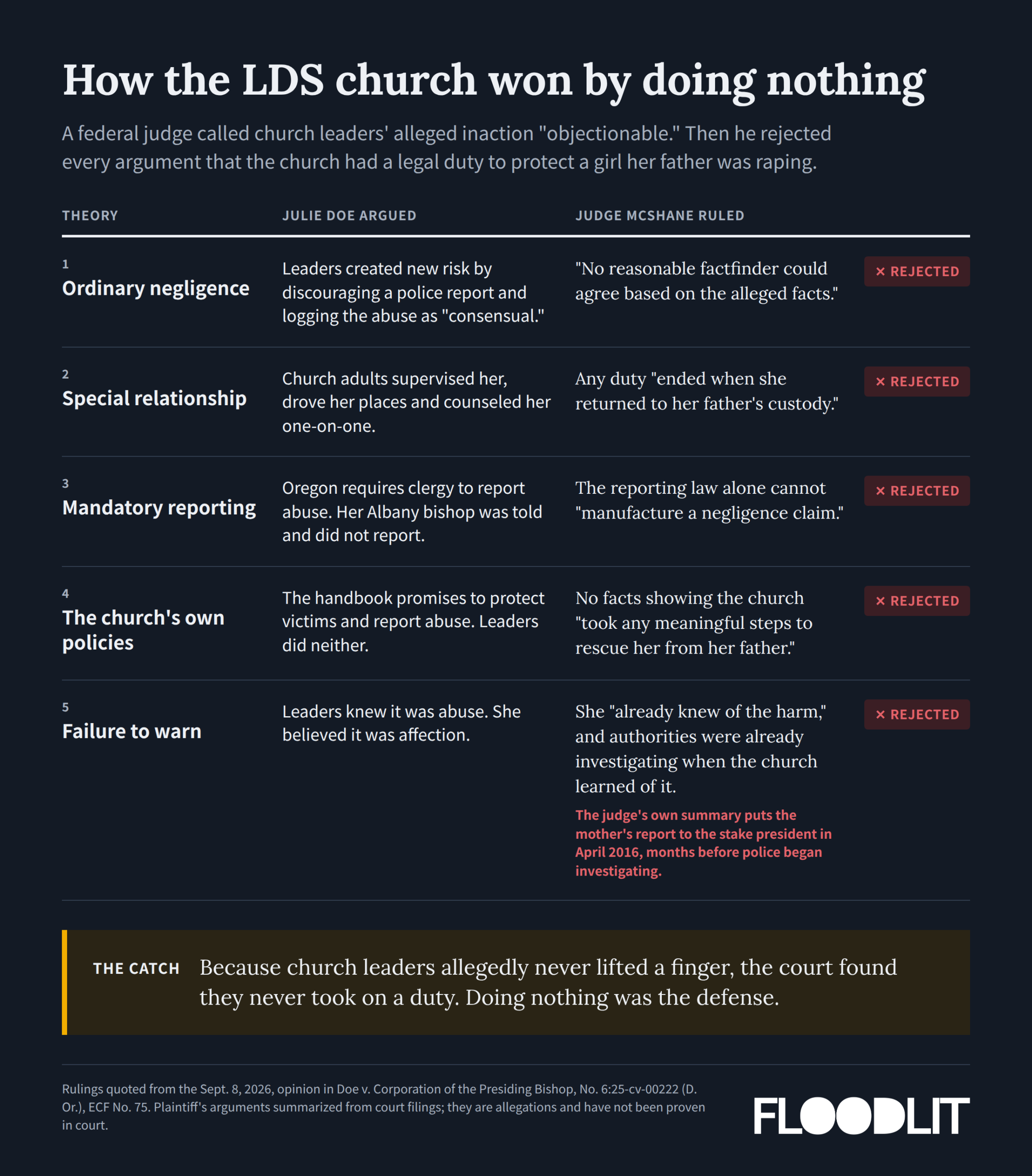
Julie’s lawyers identified five sources of a legal duty.
McShane, who described her amended complaint as bringing four negligence theories, rejected every one. “Defendants did not have or violate any duties owed to Plaintiff,” he wrote.
Craig Ford lawsuit – LDS ruling scorecard
1. Ordinary negligence. The judge relied on Stone v. Witt, 374 Or. 524, a decision the Oregon Supreme Court issued on Dec. 11, 2025.
Under that decision, a claim based only on a defendant’s failure to act must show special circumstances that justify liability.
Julie argued that church officials did more than stand by.
By discouraging a report, telling her mother nothing should be done, and logging the abuse as “consensual,” she said, they created new risks. Their response let Ford isolate her in Oregon, told Ford the church would not hold him accountable, and fueled her mother’s abuse, her lawyers argued.
McShane called that argument unconvincing. “No reasonable factfinder could agree based on the alleged facts,” he wrote.
He wrote that Julie’s allegations focus entirely on inaction.
“As objectionable as this inaction might be,” he wrote, the church did not create the risk.
He concluded it had no ordinary negligence duty to protect her from abuse in her home.
2. Special relationship. Julie argued that her church membership, the adults who supervised and drove her, and the leaders who counseled her one-on-one created a special relationship with the church.
The church argued that “no court has held that a church has a special relationship with its parishioners.”
McShane found membership alone was not enough. He cited Risley v. The Church of Jesus Christ of Latter-day Saints, a March 10, 2026, ruling by a federal court in California. That court held that churches do not have a special relationship with every child in their congregations simply because of membership.
He wrote that a special relationship may well have existed while Julie was at church activities.
But he wrote that “[a]ny special duty of care that existed when Plaintiff was under the control of Defendants ended when she returned to her father’s custody.”
She did not allege abuse while the church was supervising her.
3. Mandatory reporting. Oregon law requires clergy and other listed officials to report child abuse when they have reasonable cause to believe it occurred.
Washington did not include clergy on its list in 2016, the church noted. Julie’s statutory argument focused on the Albany leaders.
The amended complaint alleges church representatives in Albany, Oregon, knew and did not report.
McShane noted that the statute gives victims no private right to sue.
He wrote that Julie had not pointed to controlling authority showing that the reporting statute alone could “manufacture a negligence claim.”
4. The church’s own policies. Julie’s lawyers quoted the church’s own handbook at length.
It says the “first and immediate responsibility of Church leaders is to help, in a kind and sensitive way, those who have been abused and to protect vulnerable persons from future abuse,” according to the filings.
It tells leaders to “contact civil authorities immediately when it is necessary to prevent serious injury,” the filings say, because “[a] church leader’s duty to protect others is more important than the duty of confidentiality.”
McShane held that general policies, without concrete steps taken to help Julie, are not a legally binding voluntary undertaking.
“Plaintiff fails to allege facts demonstrating that Defendants took any meaningful steps to rescue her from her father,” he wrote.
“While Defendants’ policies ring disappointingly hollow,” he wrote, the allegations fell short.
The judge added a policy argument.
If Julie’s theory succeeded, he wrote, organizations with abuse-prevention policies could be held liable for harm outside their control.
That, he wrote, might discourage them from adopting such policies at all. “This Court is not willing at this time to test such a prediction.”
5. Failure to warn. Julie argued the church knew what she did not: that what Ford was doing was abuse, and that it would cause her lasting psychological harm.
The church argued it “had no special knowledge of Craig Ford or reason to warn Plaintiff of any danger,” because Pickett learned of the abuse from Julie’s mother.
McShane ruled that a warning would not have prevented the harm.
He reasoned that Julie “already knew of the harm” by the time the church learned about the abuse. He added that government authorities were already investigating “by the time Defendants first learned about it,” citing the oral argument transcript.
The judge’s own summary of the facts tells a different story.
It places the mother’s report to Pickett in April 2016, months before the Vancouver police investigation began in the fall. The near-daily rapes in Albany allegedly happened within that gap.
The same opinion also notes that Julie “misunderstood that Craig Ford’s sexual contact with her was a sign of affection.” According to her lawyers, she did not understand she was being abused at all.
McShane wrote that it would be “a step too far” to hold that any person or entity that knows of ongoing abuse and does nothing is liable under a failure-to-warn theory.
How the church fought the case
The church’s lawyers repeatedly described Ford’s abuse of a 15-year-old in the language of a relationship.
“Craig Ford commenced a sexual relationship with her,” the church’s motion says. Elsewhere it says that Ford “began having sex with her” and, after the move to Oregon, “continued having sex with her.”
Julie was a child, and Ford was her father. He was convicted of raping her.
The same motion calls Ford’s abuse “atrocious.”
The church told the court that “no church has been held liable for failing to stop intrafamily abuse.” It warned that Julie was inviting the judge to “venture … into a sea heretofore uncharted.”
It pointed to its past wins.
In a 2007 case, a Washington appeals court held the church owed no duty to two sisters abused by their stepfather, even though one of them told her bishop and he did nothing, according to the church’s motion.
In December 2025, a federal judge in Nevada rejected a similar claim against the church involving abuse by an adoptive father.
Julie’s lawyers pointed to a different case. In July 2025, the Arizona Court of Appeals found there were factual questions about the church’s duty to report a father who confessed to his bishop that he was abusing his children. The church was a party to that case.
The church also argued that Julie should not be allowed to seek punitive damages, because Washington law treats punitive damages as against public policy.
The church also cited research finding that 1 in 4 girls in the U.S. is sexually abused or assaulted by age 17. The church and its members “are not immune to this plague,” its lawyers wrote, “but any suggestion that the Church has a unique problem with child sexual abuse is baseless.”
Analysis: “Zero tolerance” in church, no duty in court
The church tells the public it has zero tolerance for abuse.
Its handbook tells leaders that protecting others outweighs confidentiality, that abuse should be reported to civil authorities, and that abusers “must” face a membership council, according to the filings.
In federal court, none of that carried legal weight.
The church sought, and won, a ruling that its written commitments to protect abuse victims did not bind it to protect this one.
The judge’s own words show how wide that gap is.
The policies, he wrote, “ring disappointingly hollow.”
When the institution faces financial liability, its protections for children exist on paper only.
Analysis: Why doing nothing protected the church
- Tort law separates misfeasance, which means doing something that creates or worsens a danger, from nonfeasance, which means failing to stop a danger someone else created.
- Anyone foreseeably hurt by misfeasance can generally sue. Nonfeasance usually leads to liability only when a special relationship or some other affirmative duty exists.
- That distinction decided this case. The church’s motion called it “unmistakably a nonfeasance case.”
- Julie argued that church leaders’ alleged discouragement of a police report, the “nothing should be done” message, and the “consensual” label helped Ford isolate her and keep abusing her.
- The court saw all of it as inaction.
- Once the conduct was classified as nonfeasance, Julie had to prove a special duty existed.
- The court found that church membership, the church’s own abuse policies, and knowing about ongoing abuse were not enough.
- The doctrine cuts the other way, too. Under the long-standing voluntary-undertaking rule, a person or organization that starts to help can be liable if it helps carelessly.
- According to the lawsuit, church leaders never started. They did not report, investigate, warn, discipline Ford, or offer Julie help.
- The judge said so directly. Julie’s undertaking claim failed, he wrote, because she did not allege “how Defendants took steps to specifically rescue her in a manner that increased her harm.”
- So the court found they had taken on nothing and owed nothing.
- The result: the more completely an institution ignores a report of child sexual abuse, the safer it is under this reading of Oregon law.
- McShane acknowledged a version of this problem himself. He worried that allowing Julie’s claim could expose “any well-intentioned entity with generalized policies” to liability, and might discourage organizations from adopting abuse policies at all.
- His ruling leaves those policies with no legal force when a child needs them.
- The court did not say the church’s conduct was acceptable.
- It said that under Oregon negligence law, as the judge read it, knowing a child is being abused and doing nothing is not enough to make an institution pay.
If you or someone you know is thinking about suicide, call or text 988 to reach the 988 Suicide & Crisis Lifeline. To report child abuse in Oregon, call 1-855-503-7233. In Washington, call 1-866-363-4276.
What is FLOODLIT.org?
FLOODLIT.org is an independent investigative newsroom.
It compiles, summarizes, and publishes public reports, records, and original articles about allegations of sexual crimes involving members of The Church of Jesus Christ of Latter-day Saints (LDS/Mormon), and about how church officials allegedly responded.
Our mission is to foster accurate discussion and promote positive change through transparent and responsible reporting, while helping abuse survivors heal.
Please contact FLOODLIT if you have any information about a Mormon sexual abuser, past or present.