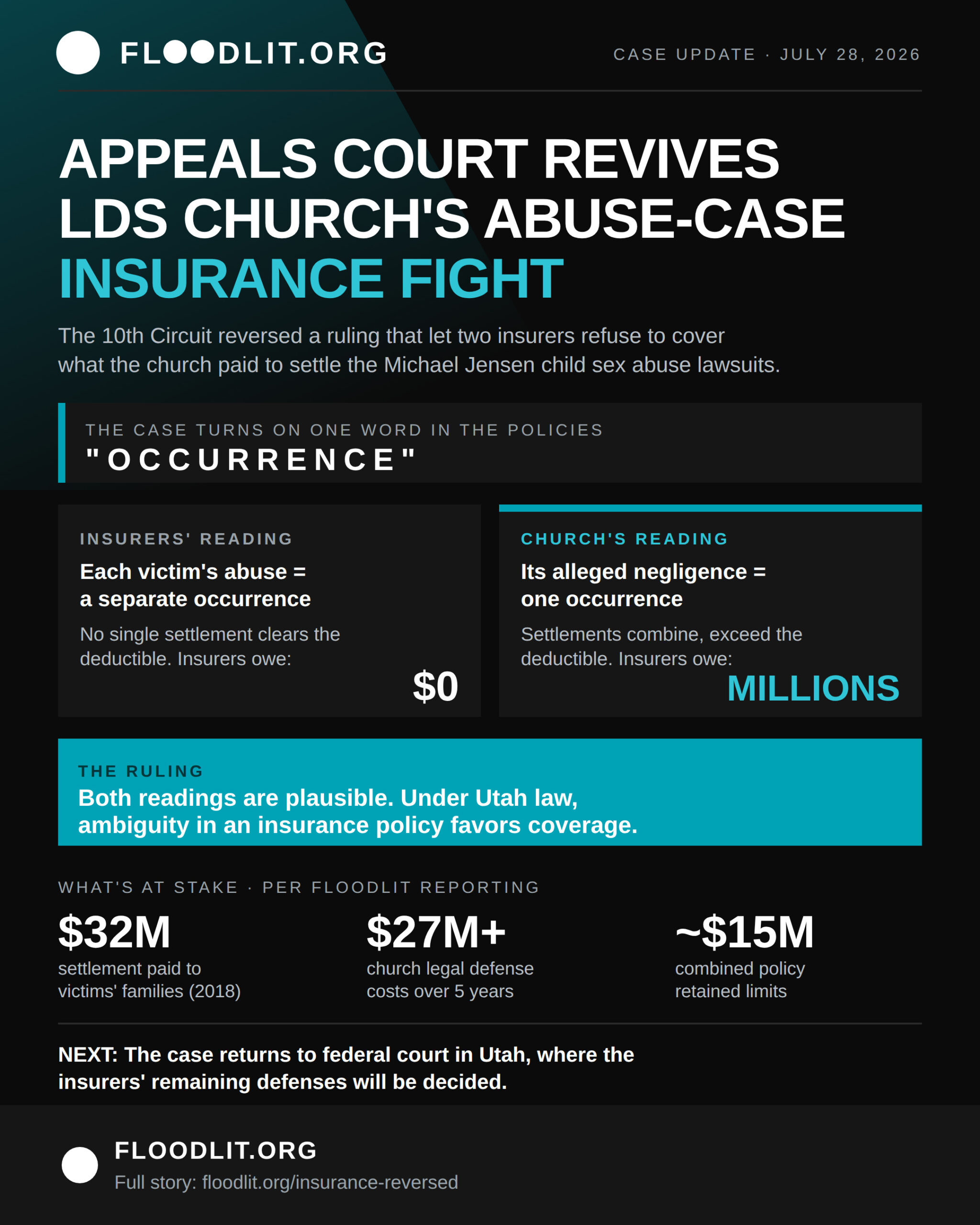
BREAKING: A federal appeals court ruled Tuesday that two insurance companies must keep fighting the Mormon church’s demand that they reimburse tens of millions of dollars the church paid to settle a West Virginia child sexual abuse lawsuit – reversing a lower court win the insurers secured last year.
DENVER – The U.S. Court of Appeals for the Tenth Circuit on July 28 reversed a Utah federal judge’s decision that had let National Union Fire Insurance Company of Pittsburgh and ACE Property and Casualty Insurance Company off the hook for the costs of defending and settling lawsuits over child sexual abuse committed by Christopher Michael Jensen, a member of The Church of Jesus Christ of Latter-day Saints (Mormon church).
The three-judge panel sent the case back to the U.S. District Court for the District of Utah for further proceedings, meaning the church’s 2021 lawsuit against its insurers is alive again.
FLOODLIT broke the story in 2025 that the church spent nearly $60 million over five years – a $32 million settlement plus more than $27 million in legal defense costs – on the lawsuit brought by West Virginia families who said church leaders failed to warn and protect their children from Jensen. The church then sued its insurers to recover those costs.
One “occurrence” or many?
The appeal turned on a single word in the insurance policies: “occurrence.”
Both policies require the church to pay a “retained limit” – functionally a deductible – for each occurrence before insurance coverage kicks in. FLOODLIT previously reported the combined retained limits total roughly $15 million. The exact figures remain under seal; the Tenth Circuit noted it withheld the actual retained limit and settlement amounts to respect a protective order shielding the victims’ identities and settlement terms.
The math decides everything
Jensen abused multiple children between 2007 and 2011. If each victim’s abuse counts as a separate occurrence, no single settlement clears the retained limit, and the insurers owe nothing. If the church’s alleged negligence – the failure to warn families and take precautions that could have stopped Jensen – counts as one occurrence, the settlements stack together, exceed the limit, and the insurers must pay the excess.
In 2025, U.S. District Judge Tena Campbell sided with the insurers, ruling that “a separate occurrence arose every time Mr. Jensen abused separate children at separate times and in separate places.”
The Tenth Circuit disagreed. Writing for the panel, Judge Gregory Phillips held that the policies’ definitions of “occurrence” are ambiguous, that the church’s one-occurrence reading is plausible, and that Utah law requires courts to resolve any ambiguity in an insurance policy in favor of coverage.
Both policies define an occurrence as an accident “including continuous or repeated exposure to substantially the same general harmful conditions,” with clauses deeming all such exposure to be a single occurrence. ACE’s version adds “regardless of the frequency or repetition thereof, or the number of claimants.” The panel found the church could reasonably read “the same general harmful conditions” to mean the dangerous environment created by its own alleged failures – making every child’s exposure to that environment part of one occurrence.
ACE argued the opposite in New Jersey
The opinion highlighted a striking contradiction: ACE itself has taken the church’s position when it suited the insurer.
In a 2024 New Jersey case involving the Catholic Diocese of Trenton, ACE argued that 87 lawsuits involving 212 abuse victims dating back to the 1940s could be treated as a single occurrence, because a “longstanding institutional policy” of covering up sexual abuse was the continuing cause of the victims’ injuries. In the church’s case, ACE argued each instance of abuse was a separate occurrence – the reading that would zero out its liability.
The panel also rejected the insurers’ warning that policyholders could flip their interpretation of “occurrence” case by case, depending on which reading pays more. “This could happen. So what?” Phillips wrote. Insurers who draft ambiguous policies, the court said, have “invited insureds to play ‘heads I win tails you lose'” – and can avoid that price by writing clearer contracts.
What happens next
The ruling does not mean the insurers must pay. It means they lost their cleanest exit.
On remand, the district court must treat the church’s one-occurrence interpretation as reasonable and work through the insurers’ remaining defenses, which the appeals court declined to decide:
- National Union says its policy expired before most of Jensen’s abuse occurred.
- ACE argues settlements can’t be aggregated across policy periods, that emotional injuries aren’t “bodily injury,” and that it owes nothing for defense costs.
Jensen, whose parents held prominent positions in the Martinsburg, West Virginia LDS community and whose grandfather was a high-ranking church employee, was convicted of sexual assault and sexual abuse in 2013 and sentenced to 35 to 75 years in prison. The families’ lawsuit, filed that same year, settled mid-trial in 2018.
The case is *Church of Jesus Christ of Latter-Day Saints v. National Union Fire Insurance Co. of Pittsburgh, PA*, No. 25-4049 (10th Cir. July 28, 2026).
FLOODLIT.org is an independent newsroom that investigates sexual abuse in The Church of Jesus Christ of Latter-day Saints. Read our full Michael Jensen case report and case timeline.
FLOODLIT.org is 100% reader supported and we depend on your donations to be able to get court documents and provide original research and reporting. Our database contains over 4,200 case reports related to sexual abuse and sex crimes allegedly perpetrated by active members or leaders in the Mormon church.