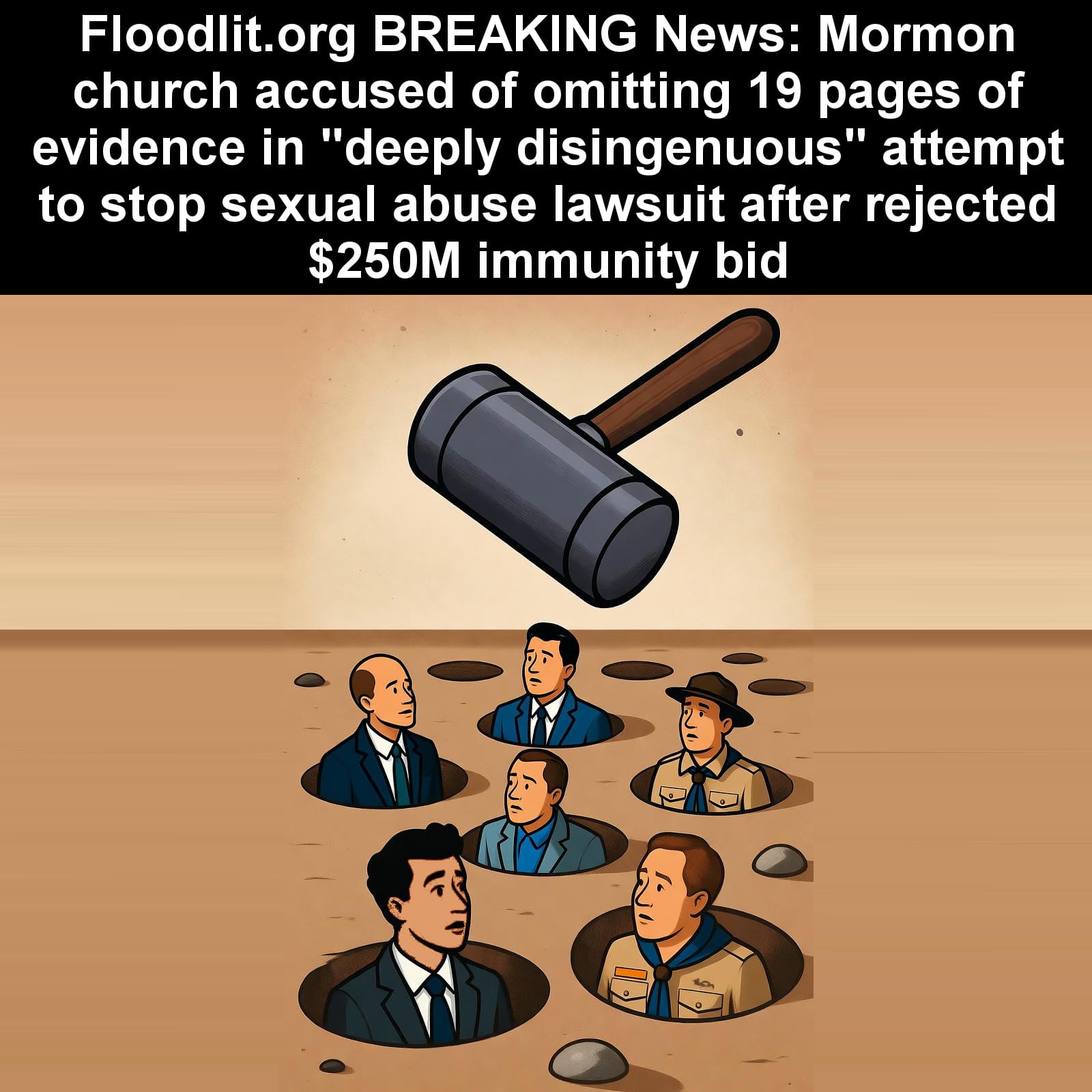
Floodlit, an independent newsroom reporting on sexual abuse in The Church of Jesus Christ of Latter-day Saints, has obtained documents revealing a legal battle in the U.S. Bankruptcy Court for the District of Delaware, as part of the Boy Scouts of America (BSA) bankruptcy proceedings.
This article is part of a series of Floodlit special reports on alleged coverups or failures by Mormon officials regarding sexual abuse.
Report outline
- “Deeply disingenuous”: a $250 million rejection and an ongoing battle
- “Permanently channeled”: the Mormon church’s $250 million proposal
- “Substantial and certain payment”: Mormon risk manager’s rationale vs. survivors’ reality
- The “Mixed Claims” problem
- Blurred lines: a century of intertwined church and Scouting activities
- “Unwritten gentlemen’s agreements”: a 2003 letter with key details
- “Handled confidentially”: Patterns of privacy and promoting BSA/Mormon handlers
- John Fanning: encouraged to”seek professional counseling”
- Keven Nelson: “handled confidentially”
- Michael Terry Stillman: “follow up on this swiftly and take the appropriate action”
- Two Oregon trails of Mormon destruction
- Ed Dyer: “Silence is the major problem of the whole thing”
- Jim Hogan: The case that ruined the church’s $250 million proposal
- The judge’s razor-sharp rejection
- Jim Hogan revisited: “The Bishop said not to worry about it at all”
- “Jim has a great love for young people”
- “Both Presidents […] are positive he is capable of working with youth”
- “REFUSE – TAKE OFF PROBATION – LAWSUIT AGAINST LDS CHURCH”
- When was Jim Hogan actually excommunicated?
- Echoes in 2025: The Maryland Lawsuit, and an abuser’s “180 degree shift”
- Maryland Lawsuit: Latest Updates
- An avalanche of “mixed” abuse
- Where do we go from here?
“Deeply disingenuous”: a $250 million rejection and an ongoing battle
In July, attorneys for a Maryland abuse survivor accused the church, commonly known as the Mormon church, of filing a “deeply disingenuous” motion to force him to dismiss a lawsuit alleging failures by church officials and Mormon billionaire Bill Marriott.
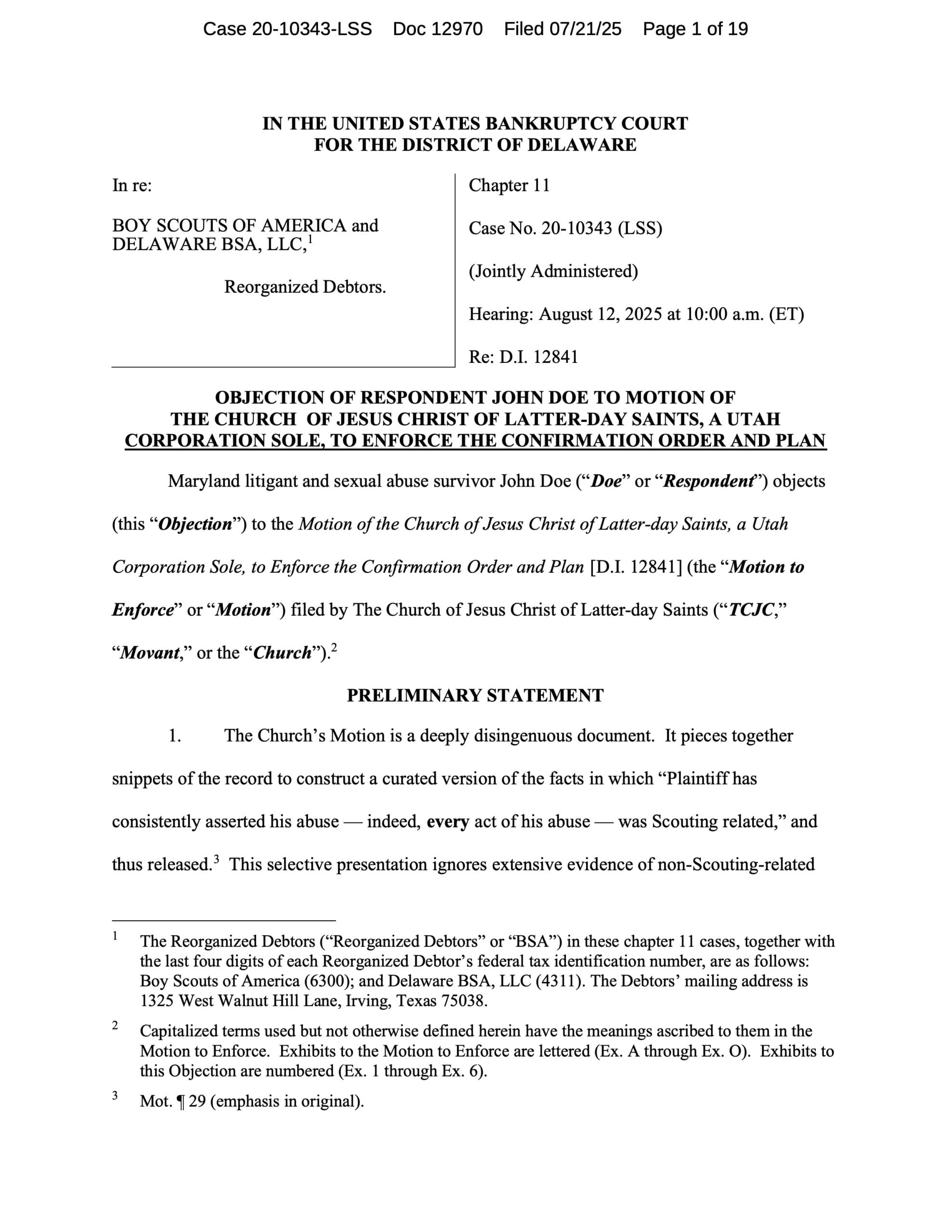
Doe objection in BSA bankruptcy to LDS church motion re Maryland lawsuit, July 21, 2025, page 1
The suit says the abuse began at Marriott’s home in 1995, before perpetrator Richard Kent James became a Scoutmaster. The victim, known as John Doe in the lawsuit, was 12 years old. James was convicted in 2002 of abusing Doe, but his attorney stated at sentencing that the abuse “did not happen on scouting activities.”
The church is now arguing that Doe’s abuse claim is exclusively Scouting-related, thereby channeling it to the BSA settlement trust.
In 2022, bankruptcy judge Laurie Selber Silverstein rejected a proposal by the Mormon church where it would pay $250 million into the BSA settlement trust in exchange for a release from liability in “Mixed Claim” cases, where some of the alleged abuse occurred outside of Scouting.
Doe’s attorneys say the church omitted 19 pages of critical evidence and “piece[d] together snippets of the record to construct a curated version of the facts.”
They wrote:
To accept [the church’s] argument now would be to give it for free something that the Court was not willing to let it buy for $250 million in 2022.
The upcoming ruling could impact the ability of abuse victims to seek recovery for damages from the church.
For this report, Floodlit combed through news reports and legal documents dating back to the 1950s. We want to provide you with a deeper understanding and more complete perspective of the history of the relationship between the Mormon church and the BSA, in order to underscore the significance of the documents we recently uncovered regarding the ongoing Maryland lawsuit.
Your support makes our reporting possible. Please consider supporting Floodlit with a donation today.
Donate to help Floodlit get records
Now, let’s get into it.
“Permanently channeled”: the Mormon church’s $250 million proposal
In 2020, plagued by hundreds of sex abuse lawsuits, the BSA filed for bankruptcy. It emerged as Scouting America in 2023, but numerous loose ends and legal battles remain.
The next year, the Mormon church, which ended its 105-year affiliation with the BSA at the close of 2019, offered $250 million to the settlement trust in exchange for immunity from all present or future abuse claims tied to Scouting in any capacity. No one would be able to recover damages in such cases anywhere outside of the settlement trust:
“Pursuant to the Channeling Injunction, any Abuse Claim in connection, in whole or in part, with [the Church]’s involvement in, or sponsorship of, one or more Scouting units […] shall be permanently channeled to the Settlement Trust […] and may not proceed in any manner against [the Church] in any forum whatsoever, including any state, federal, or non-U.S. court or any administrative or arbitral forum.” (Sixth Mediators’ Report, Exhibit B “TCJC Term Sheet”, Sept. 14, 2021, p. 6. Case 20-10343-LSS Doc 6210-2)
“Substantial and certain payment”: Mormon risk manager’s rationale vs. survivors’ reality
On March 19, 2022, longtime church risk management director Paul Rytting submitted a statement to the bankruptcy court in support of the church’s $250 million proposal. He wrote (emphasis ours):
Many survivors, in my experience, would receive no compensation in the tort system due to statutes of limitations, and these Chapter 11 cases allow [the church] to provide the survivors with a substantial and certain payment.
However, for many claimants, payments have proven neither substantial nor certain. To date, only about 10% of the total payout has been distributed. Thousands remain unpaid entirely, including more than 2,000 who have passed away without receiving a penny.
The “Mixed Claims” problem
In an objection filed regarding the church’s approach, the PCVA and Zalkin law firms told Judge Silverstein about two of their clients:
In Moorestown, New Jersey, church officials allegedly knew of child sexual abuse allegations against David James Borg, yet assigned him as a Scout leader and LDS young men’s president. Borg then groomed and abused a boy during both church and Scouting activities.
In Mayer, Arizona, church officials permitted Robert Gene Metcalf to volunteer in Scouting after his excommunication and six-year imprisonment for anally raping a boy. Metcalf subsequently abused multiple children in and outside of Scouting.
Later in this report, we’ll share examples of similar cases we’ve found. In the BSA bankruptcy, these were referred to as “Mixed Claims.”
The firms stated:
With approximately 7,716 [LDS]-related Abuse Claims on file in this Chapter 11 Case, there are undoubtedly countless additional examples […]. [The church] faces […] liability to these claimants […], yet is asking this Court to bar these victims from suing [it] even for sexual abuse that is not Scouting-related.
Floodlit has 2,854 case reports in our database on alleged abusers identified in the BSA bankruptcy as affiliated with units explicitly linked to the Mormon church.
Nearly 5,000 other claims submitted to the bankruptcy court involved units where the troop or claim number aligned with church-sponsored units, but the church was not explicitly named by survivors. We have withheld these from our database due to insufficient verification.
Unfortunately, obtaining further details may prove impossible, as the names of alleged abusers were sealed during the bankruptcy proceedings.
Blurred lines: a century of intertwined church and Scouting activities
The LDS church’s century-long relationship with the BSA blurred distinctions between religious youth programs and Scouting, complicating abuse victims’ efforts to recover damages.
As Judge Silverstein noted in her 2022 opinion (emphasis ours):
It is undisputed that Scouting was the official activity program for young men affiliated with [the church] beginning in the 1920s and that all boys involved with the church were automatically enrolled in Scouting at age 8.
Church officials reinforced this integration, presenting Scouting as inseparable from doctrinal and youth activities. Boys attended for spiritual fellowship and like-minded engagement, yet Scouting was invariably included, with no opt-out provided.
“Unwritten gentlemen’s agreements”: a 2003 letter with key details
On March 7, 2022, 12 days before Rytting filed his “substantial and certain payment” statement, Michael Merchant, an attorney representing the church, submitted 800 pages of documents in support of the $250 million settlement offer.
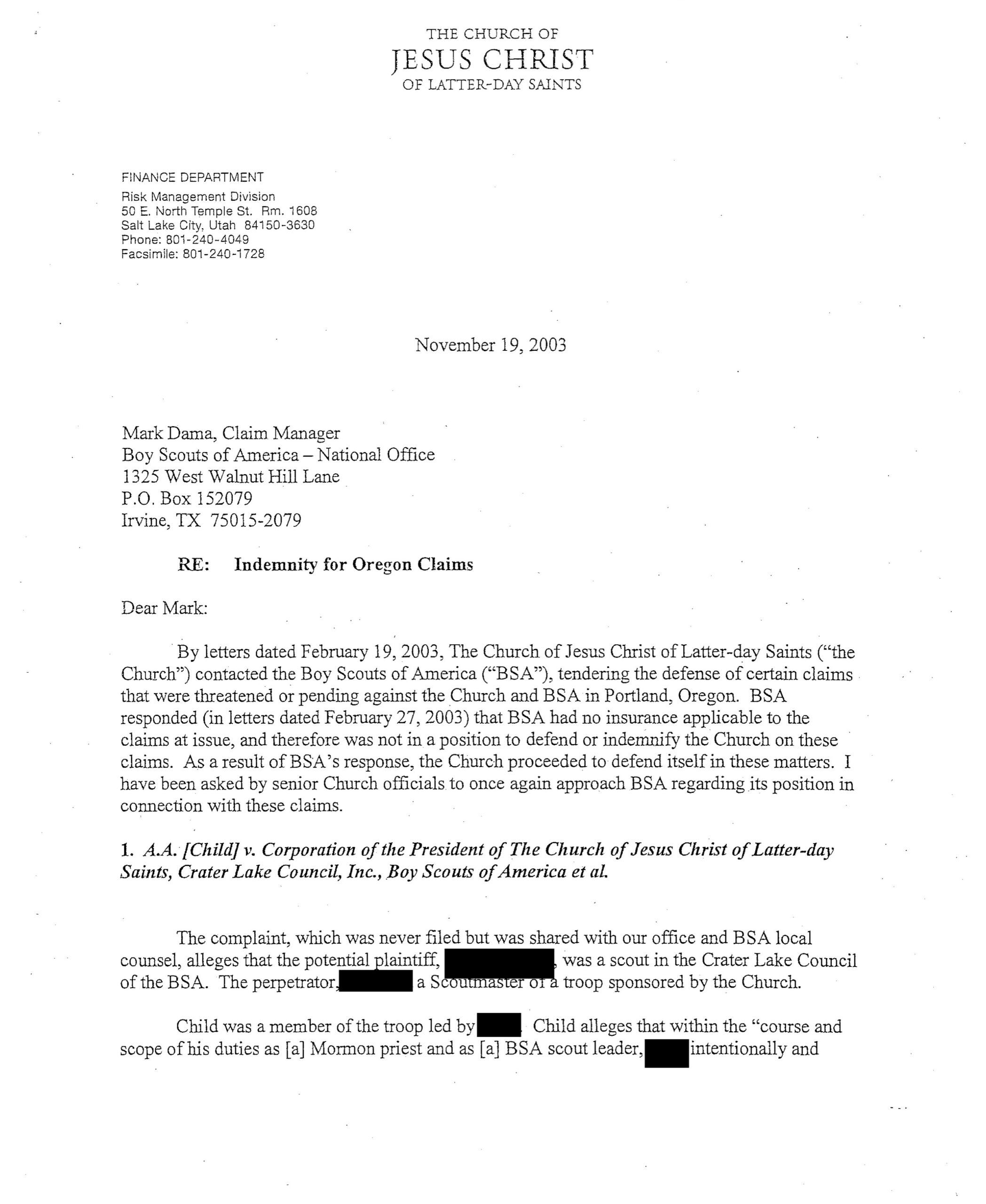
Buried among the 50 attached exhibits was a 2003 letter from Rytting to BSA claims manager Mark Dama.
Full report on Rytting’s letter
-

- LDS church risk manager Paul Rytting letter to BSA claims manager Mark Dama, Nov. 19, 2003, p. 1
-
- LDS church risk manager Paul Rytting letter to BSA claims manager Mark Dama, Nov. 19, 2003, p. 2
-
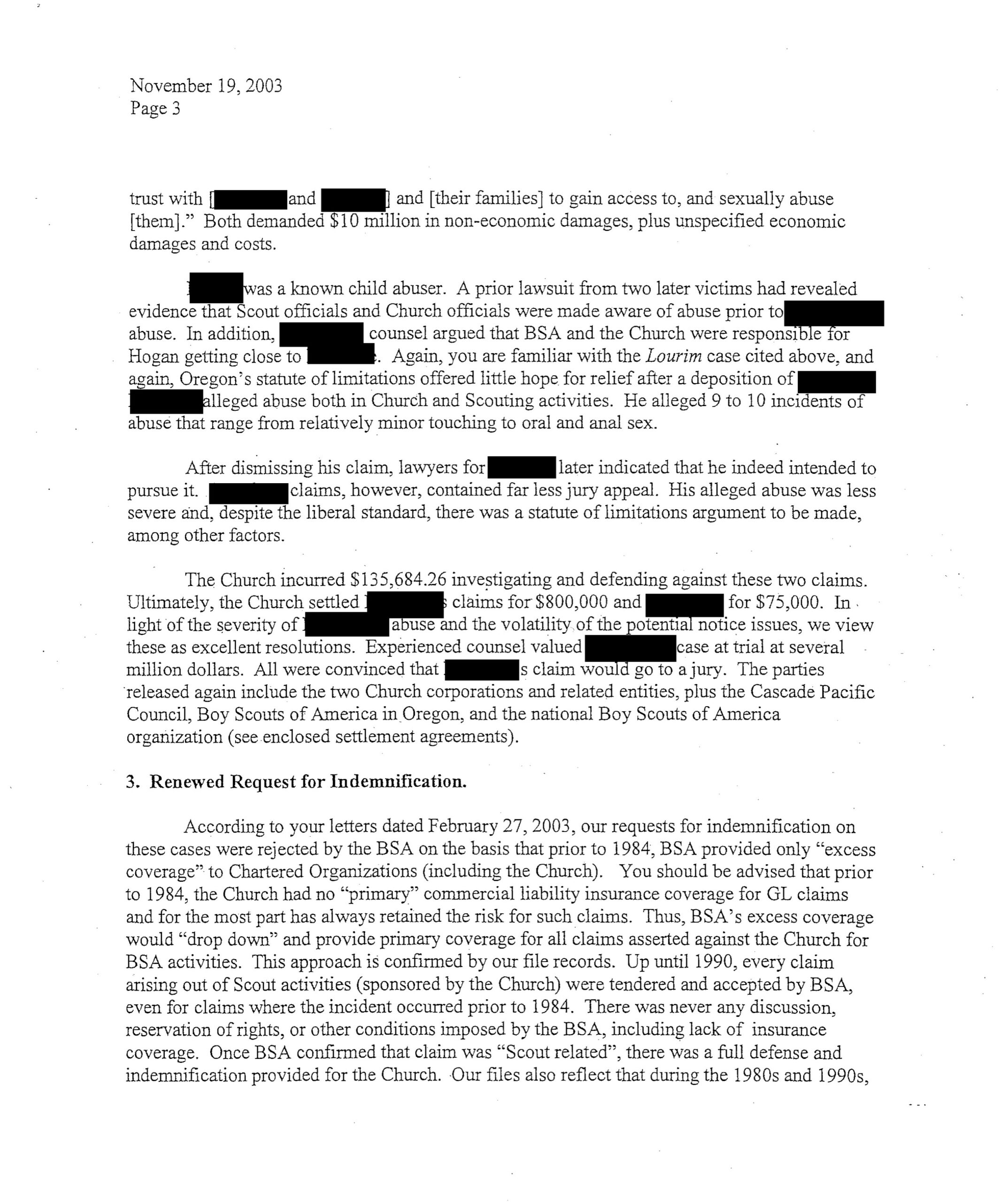
- LDS church risk manager Paul Rytting letter to BSA claims manager Mark Dama, Nov. 19, 2003, p. 3
-
- LDS church risk manager Paul Rytting letter to BSA claims manager Mark Dama, Nov. 19, 2003, p. 4
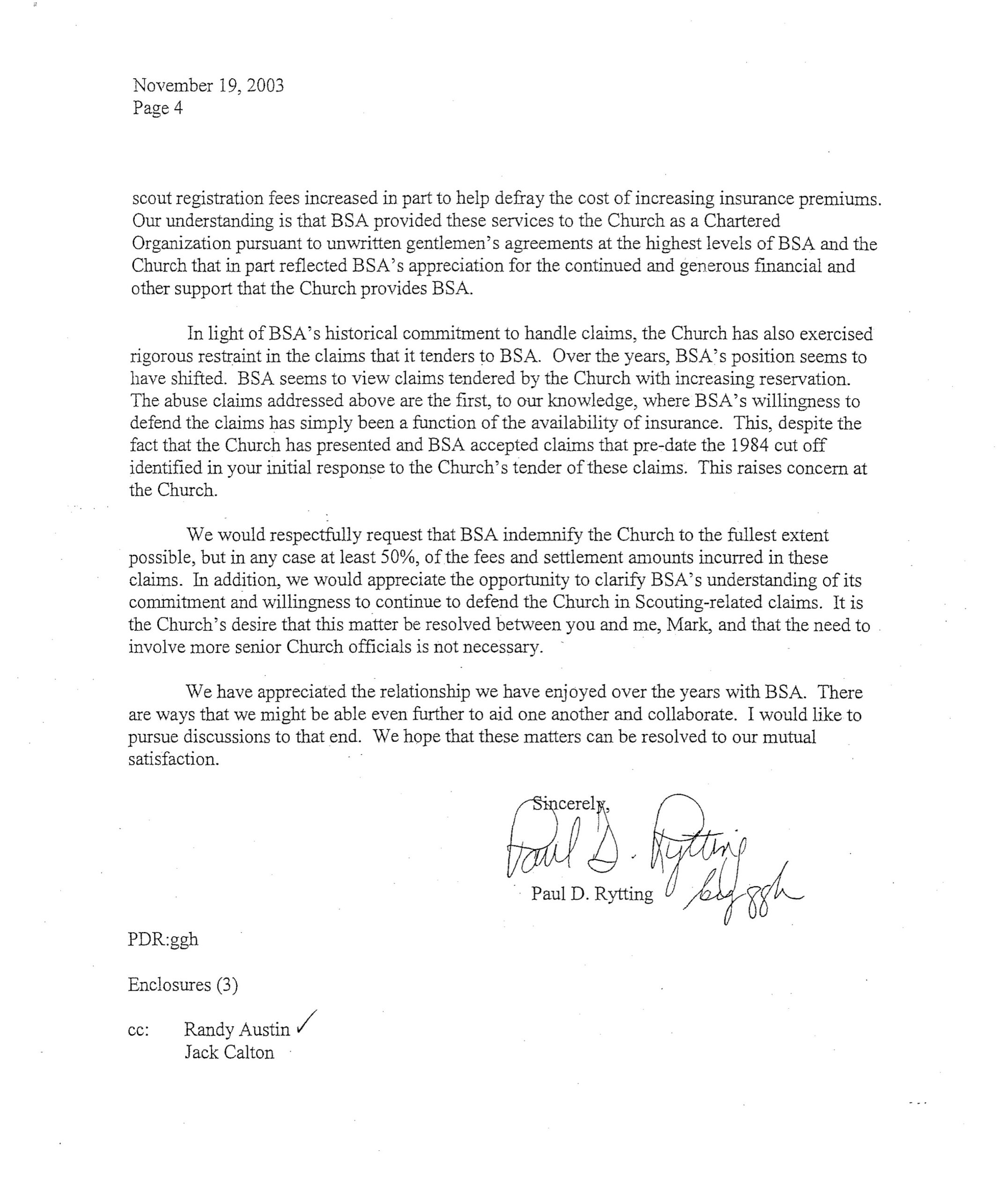
As discussed later in this report, Judge Silverstein identified a critical detail in Rytting’s letter that undermined the church’s proposal.
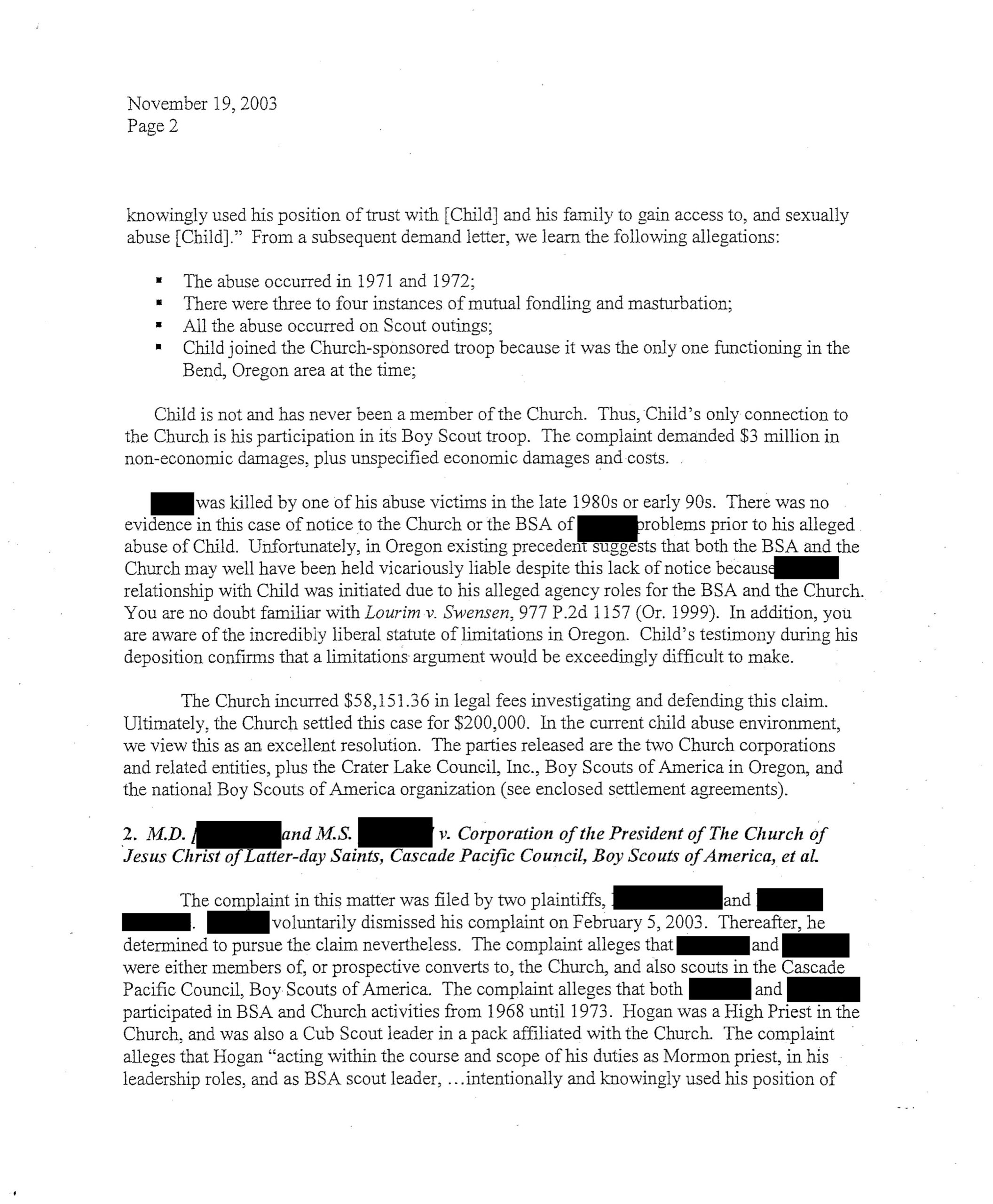
In the four-page letter, Rytting reminded Dama of “unwritten gentleman’s agreements at the highest levels of BSA and the Church” while seeking reimbursement for “at least 50% of the fees and settlement amounts” the church spent to defend and settle three Oregon child sex abuse claims.
In total, the church spent $1,075,000 to settle the claims, plus $193,835.62 to investigate and defend against them.
Calling the results “excellent resolutions,” Rytting cited Oregon’s “incredibly liberal statute of limitations” and counsel’s assessment of one claim as worth “several million dollars.”
Oregon had long been a challenging legal arena for the church, with lawsuits against abusive Scoutmasters dating to the 1980s and statutes affording victims extended filing periods.
Addressing Dama directly, Rytting said senior church officials wanted the two men to continue discussions. He closed:
There are ways that we might be able even further to aid one another and collaborate. I would like to pursue discussions to that end. We hope that these matters can be resolved to our mutual satisfaction.
“Handled confidentially”: Patterns of privacy and promoting BSA/Mormon handlers
PAUSE … we need to talk about confidentiality.
Floodlit’s records indicate that for decades, BSA and Mormon officials collaborated to maintain confidentiality in child sexual abuse investigations.
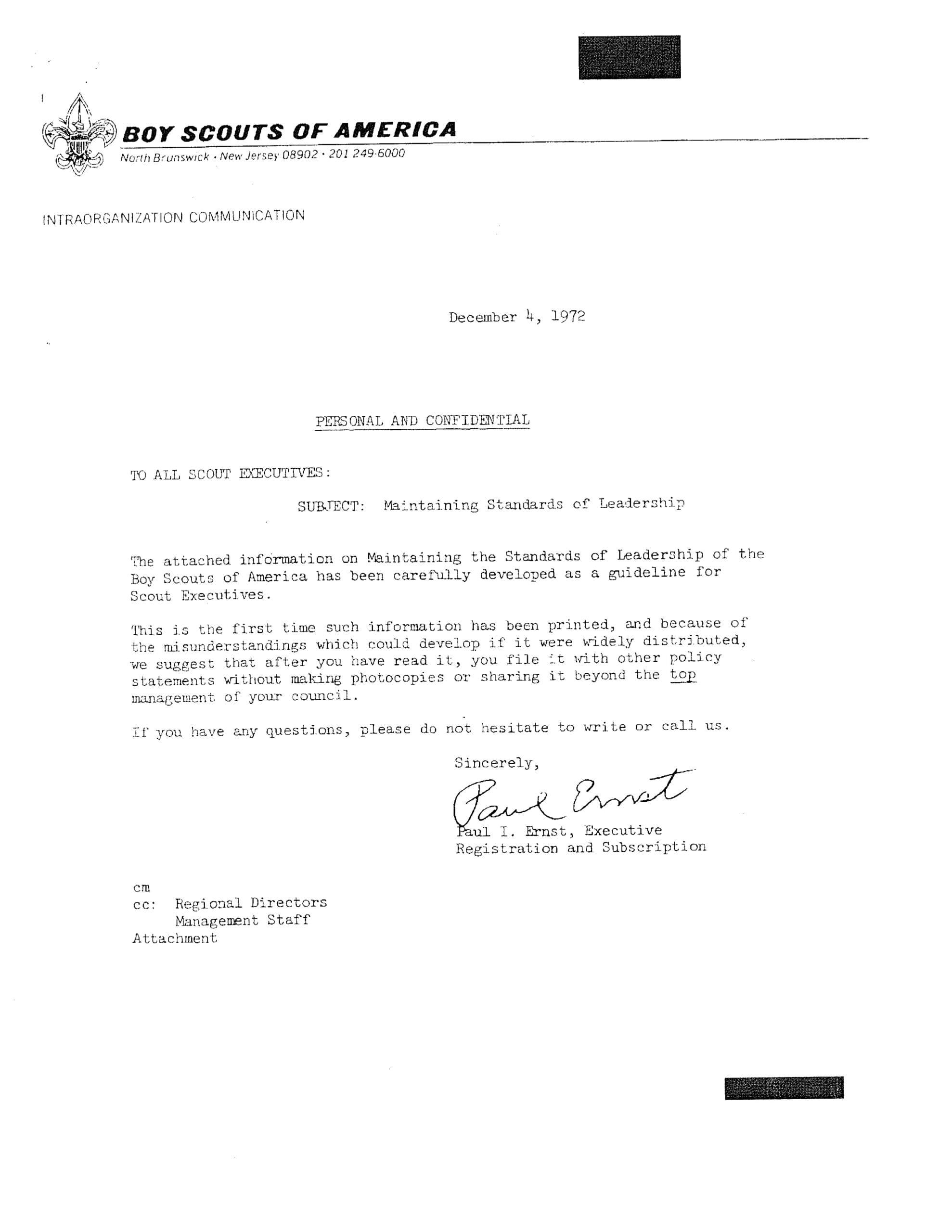
From 1971 to 1993, Paul Ernst was the BSA’s director of Registration and Subscription Services. As part of his duties, Ernst oversaw the BSA’s “perversion files” – its own shorthand name for its internal dossiers on alleged sexual predators in its ranks.
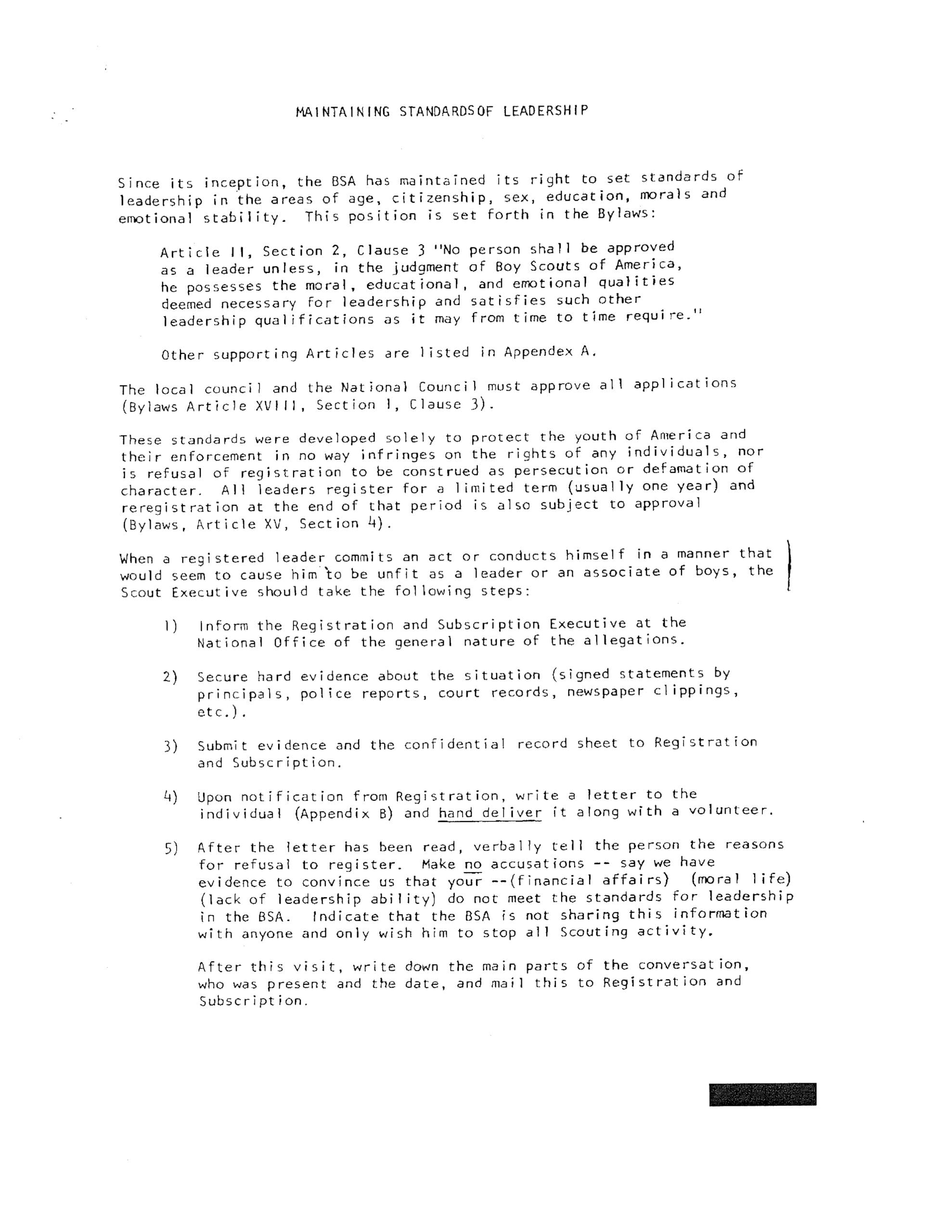
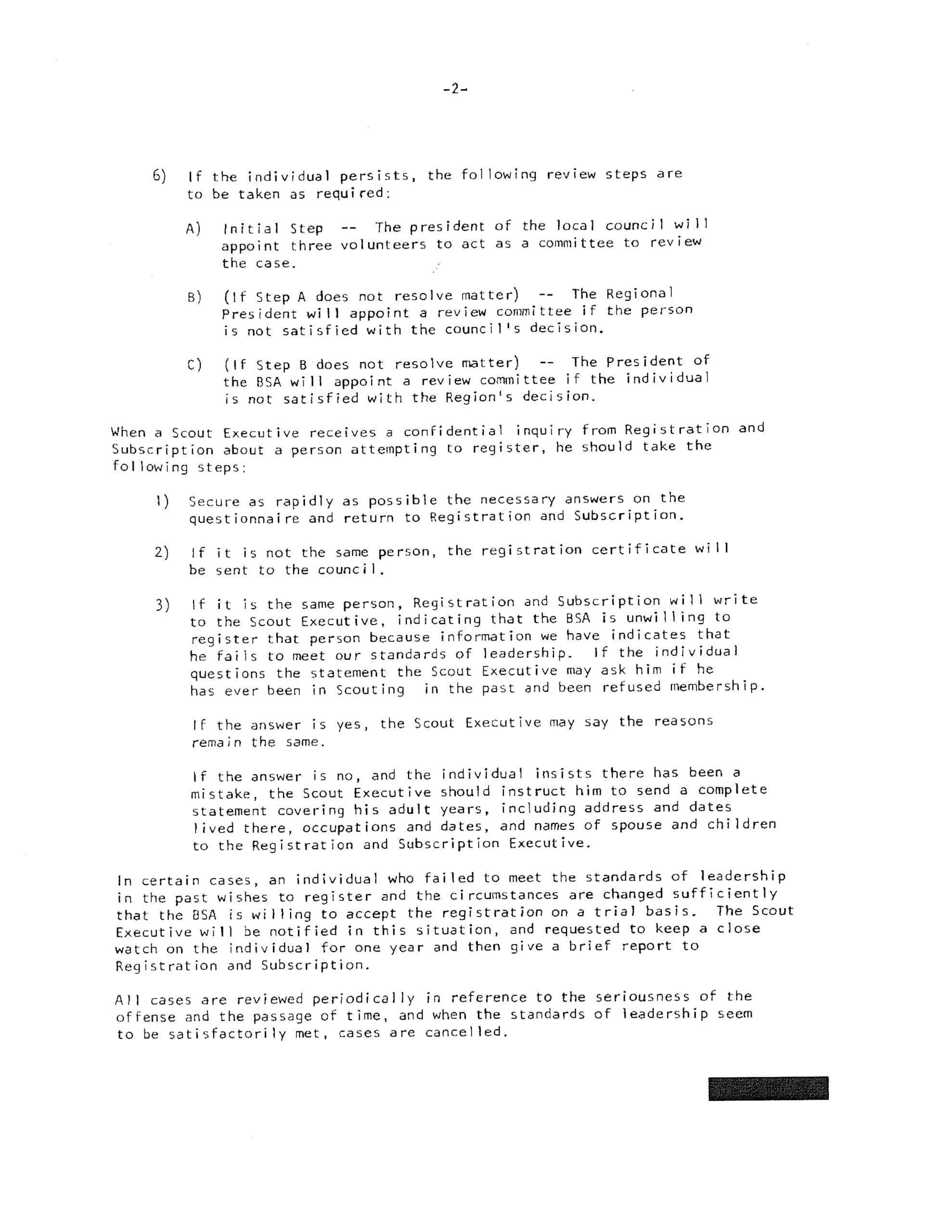
In 1972, Ernst sent written instructions to all professional Scout executives (regional paid staff managing Scouting) on what to do “when a registered leader commits an act or conducts himself in a manner that would seem to cause him to be unfit as a leader or an associate of boys.”
-
- BSA registration head Paul Ernst letter to all Scout executives, 1972, p. 1
-
- BSA registration head Paul Ernst letter to all Scout executives, 1972, p. 2
-
- BSA registration head Paul Ernst letter to all Scout executives, 1972, p. 3
-
- BSA registration head Paul Ernst letter to all Scout executives, 1972, p. 4
-
- BSA registration head Paul Ernst letter to all Scout executives, 1972, p. 5

-
- BSA registration head Paul Ernst letter to all Scout executives, 1972, p. 6
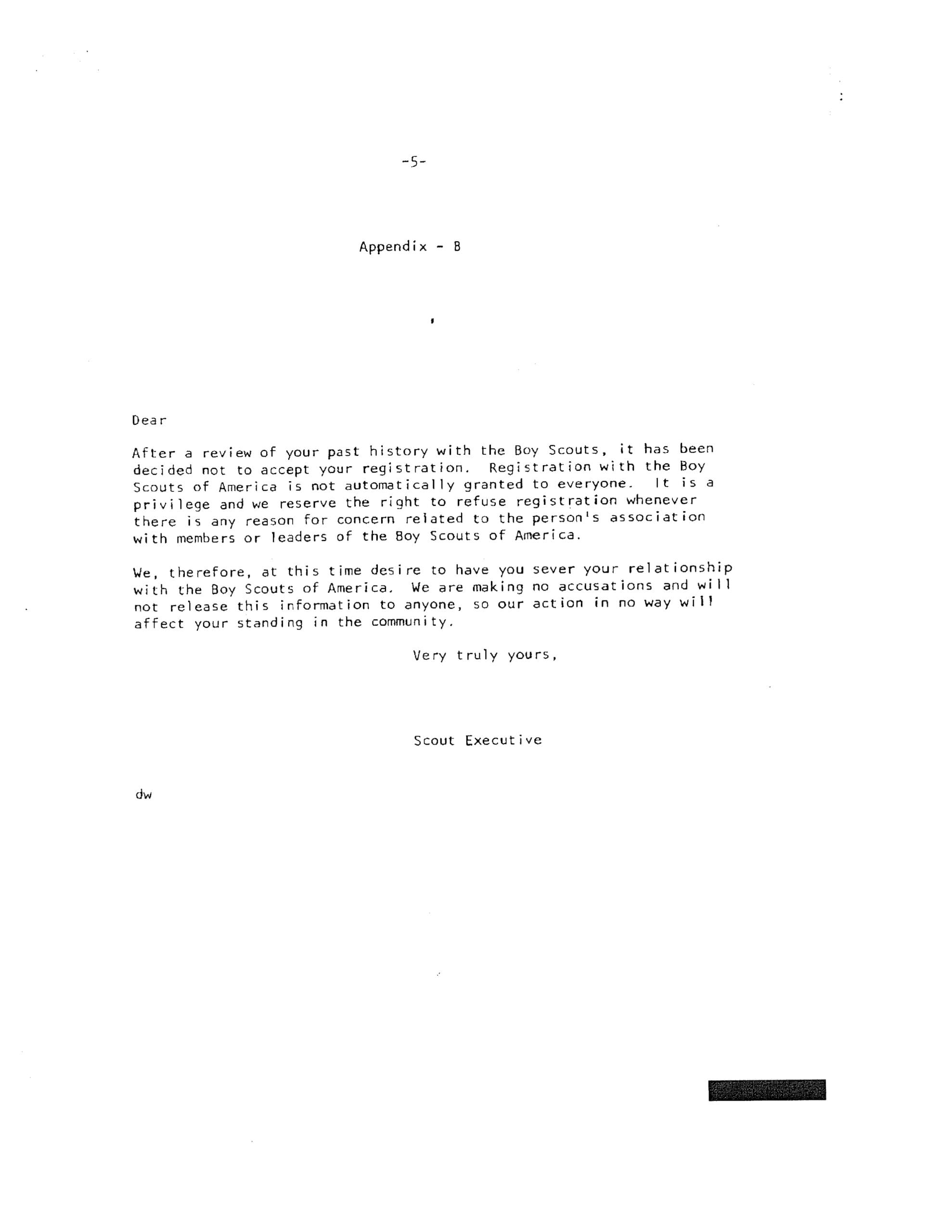
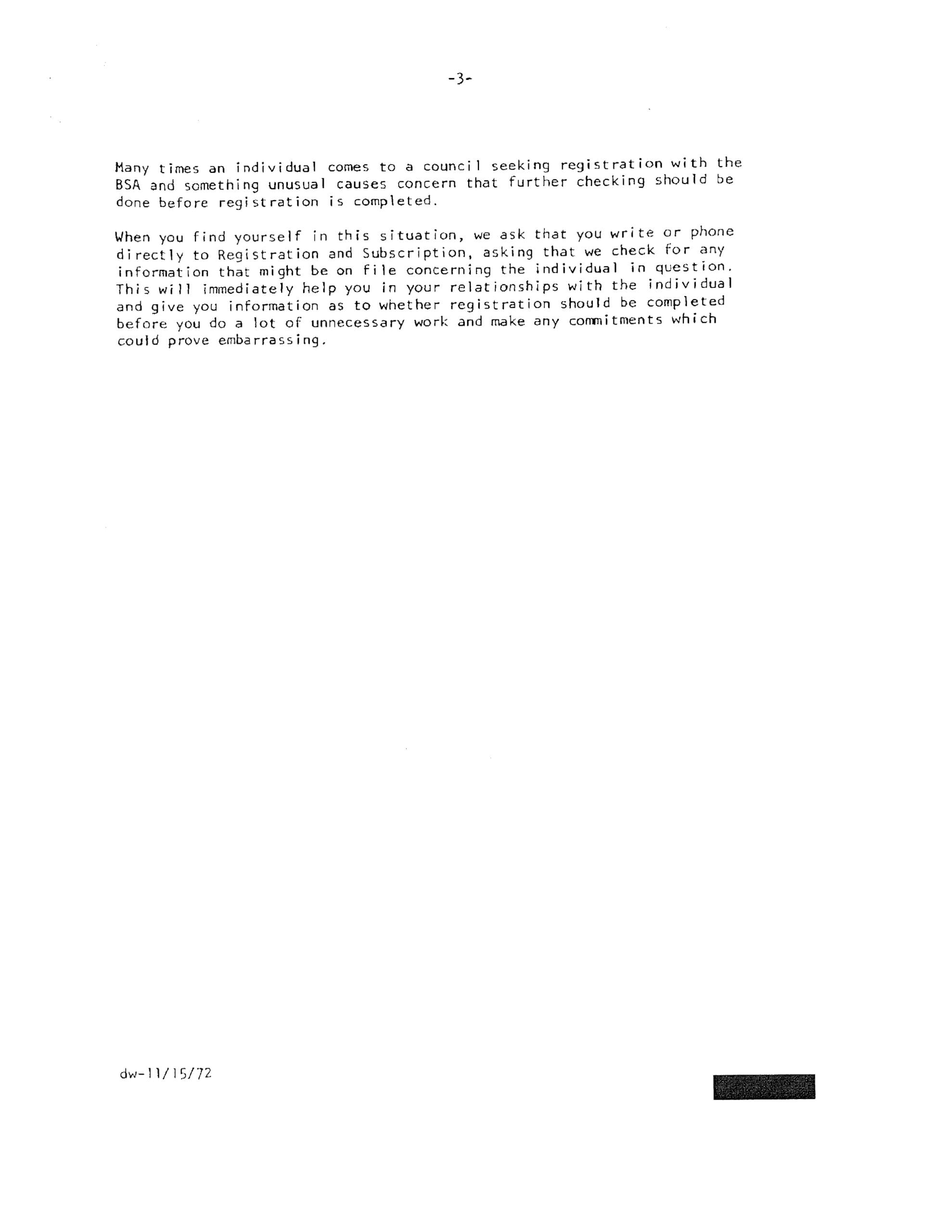
Scout executives were to “secure hard evidence”, submit it with a “confidential record sheet” (to become the file’s opening page), and “hand deliver” (underlined in original) a boilerplate letter assuring the accused:
We are making no accusations and will not release this information to anyone, so our action in no way will affect your standing in the community.
Executives were instructed to “verbally tell the person the reasons for refusal to register” but to “make no accusations.”
They were to “indicate that the BSA is not sharing this information with anyone and only wish him to stop all Scouting activity.”
Notably absent: directives to contact police, civil authorities, victims’ parents, or halt the abuse.
Floodlit’s prior reports confirm that each LDS-BSA Relationships Director from 1963 to 1989 (a paid BSA position held by a Mormon man) had prior Scout executive roles and corresponded with BSA headquarters on sexual abuse allegations.
We continue searching for historical BSA and church documents on the development of confidentiality policies and practices for abuse allegations.
The following three cases exemplify adherence to the BSA’s 1972 guidelines issued by Ernst.
In each case, involved BSA professionals later received promotions from the BSA or church.
John Fanning: encouraged to “seek professional counseling”
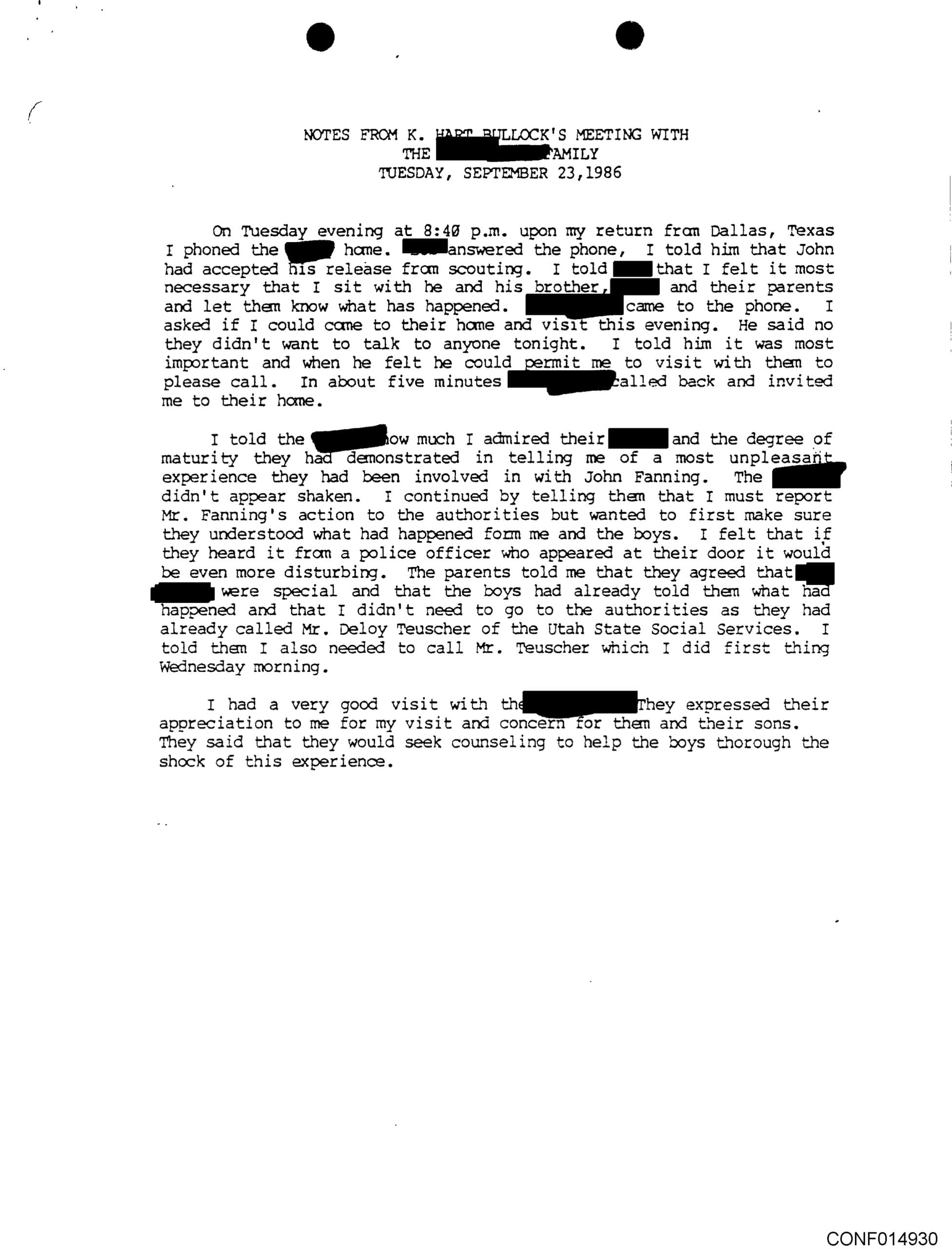
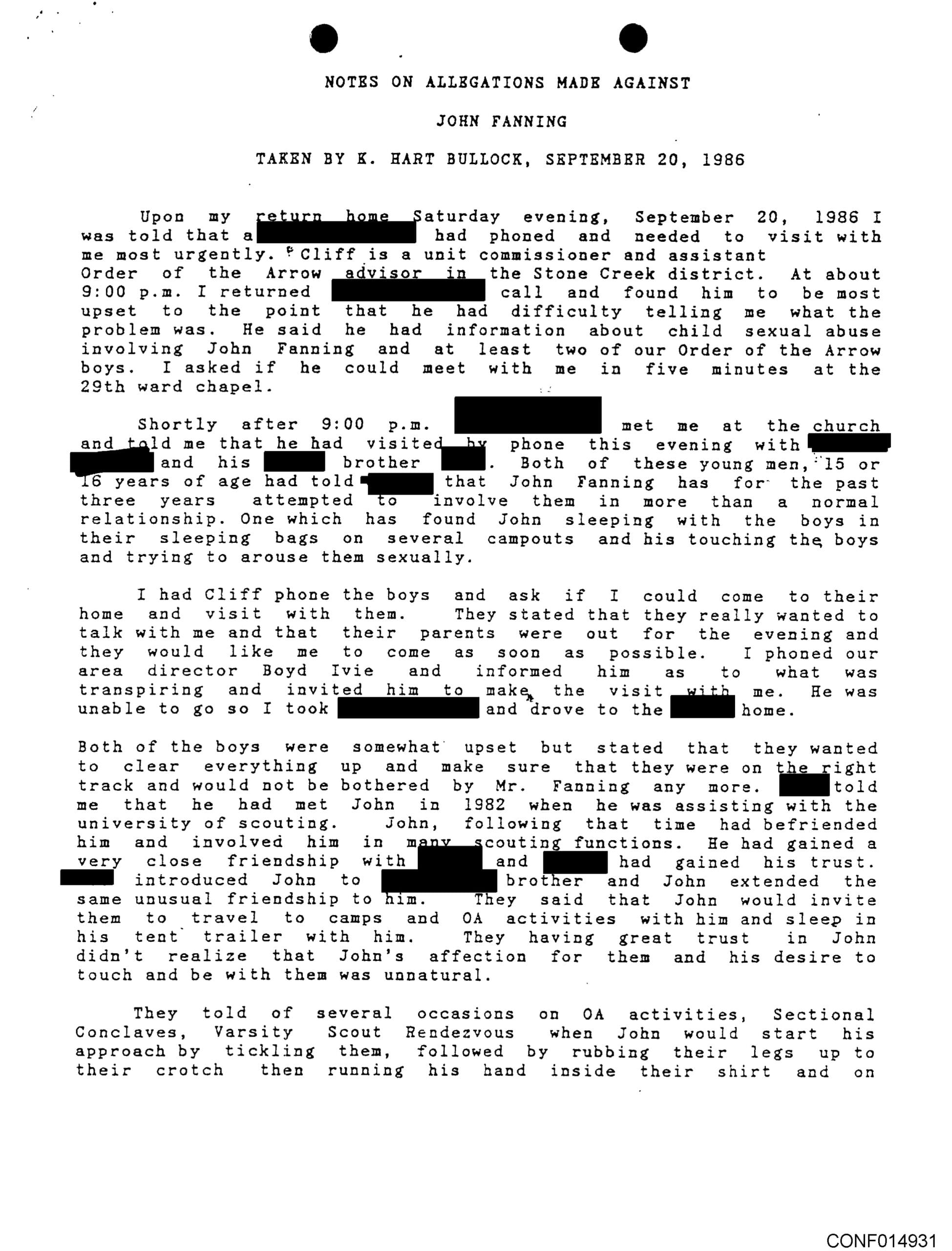
In 1986, Great Salt Lake Council Scout Executive Hart Bullock learned of child sexual abuse allegations against John Fanning, a paid BSA executive who was a former Mormon branch president and bishop.
Instead of alerting police, Bullock followed Scouting protocols. He arranged a private meeting in his office two days later with Fanning and area director Boyd Ivie, Bullock’s superior. Bullock and Ivie were both Latter-day Saints.
-
- John Wood Fanning BSA perversion file, p. 7 – Hart Bullock’s notes from meeting with Fanning and Boyd Ivie
-
- John Wood Fanning BSA perversion file, p. 9 – Hart Bullock’s notes from meeting with two victims and their parents
-
- John Wood Fanning BSA perversion file, p. 10 – Hart Bullock’s notes on abuse allegations
-
- John Wood Fanning BSA perversion file, p. 11 – Hart Bullock’s notes on abuse allegations
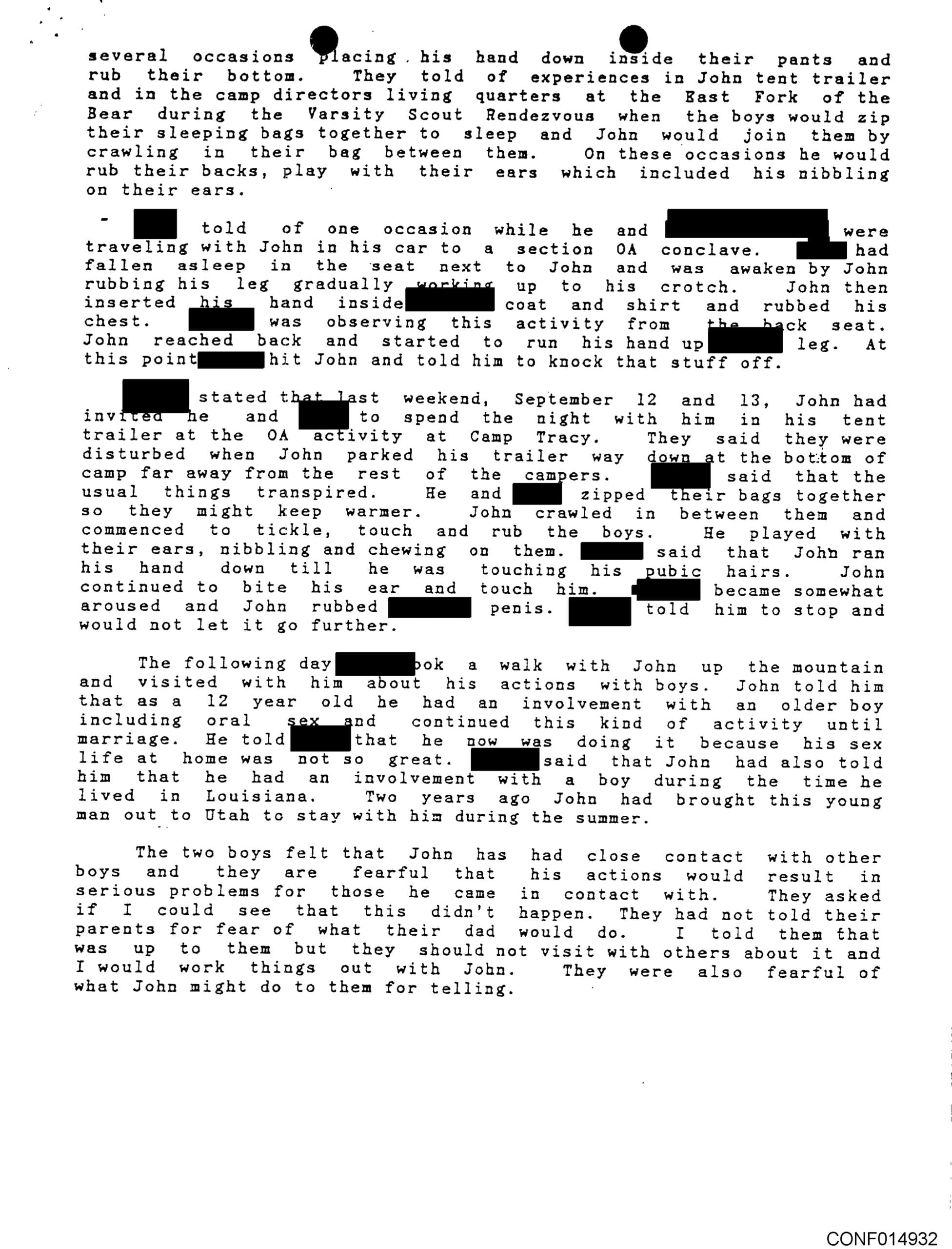
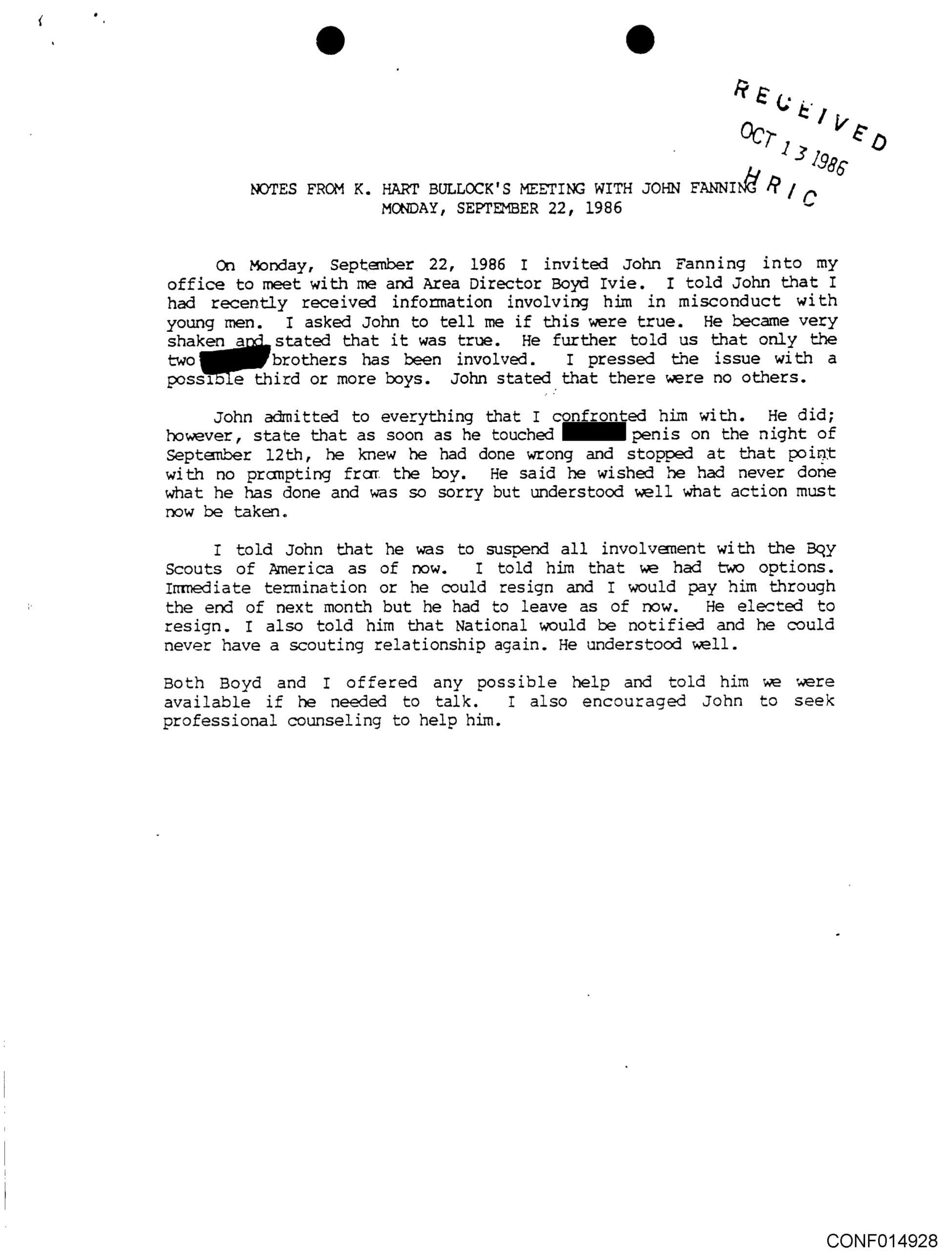
According to Bullock’s report of the meeting, he asked Fanning if allegations were true that he had perpetrated “misconduct with young men.” Fanning “become very shaken and stated that it was true.”
Bullock told Fanning he was suspended, then asked him if he preferred to to be terminated immediately “or he could resign and I would pay him through the end of next month but he had to leave as of now.”
Fanning took the second option.
Bullock and Ivie “offered any possible help and told [Fanning] we were available if he needed to talk.” Bullock also “encouraged [Fanning] to seek professional counseling to help him.”
After the meeting, neither Bullock nor Ivie called the police.
Instead, the next day, Bullock met privately with the victims’ parents and told them he planned to report Fanning to the authorities after speaking with them. They told him he didn’t need to, as they had already called DeLoy Teuscher, a worker with the Utah State Social Services, who was a mandated reporter. (He was also a former Mormon bishop.)
During the April 1989 LDS general conference priesthood session, church president Ezra Taft Benson received the Bronze Wolf, the highest award in international Scouting. The Deseret News reported Bullock and Ivie’s attendance as BSA representatives.
In 1992, the BSA appointed Bullock as LDS-BSA Relationships Director.
Keven Nelson: “handled confidentially”
In 1988, two Idaho Scout officials met with Keven Nelson, who had been accused of “sexual mis-conduct with some youth members of our Order of the Arrow Lodge.” Nelson was an advisor for the lodge’s youth leaders.
Following protocol, the BSA officials handed Nelson a suspension letter, citing “moral related reasons.” The letter was signed by Harold Hillam, president of the Teton Peaks Council. They gave Nelson two paychecks and assured him that “everything transpiring regarding this matter was being handled confidentially.”
Their report concluded:
Keven had no other matters to discuss. We then shook hands and Keven departed.
Floodlit was unable to find evidence of any reports to police by either of the officials who met with Nelson, or by council president Hillam.
Nelson was never criminally charged.
Hillam ascended in the church to the following ranks: the Second Quorum of the Seventy in 1990, the First Quorum in 1993, Presidency of the Seventy and Sunday School general president from 1995 to 2000, and Boise Idaho Temple president from 2005 to 2008.
Michael Terry Stillman: “follow up on this swiftly and take the appropriate action”
In 1989, Michael Terry Stillman, a district Scout executive in Sevier County, Utah, was placed in the BSA perversion files for alleged sexual abuse of a 13- to 15-year-old boy in the mid-1970s.
Michael Terry Stillman case report
The survivor, age 28 in 1989, reported the alleged abuse to St. George Mormon bishop Mark Gubler, who called Scout executive Rees Falkner, also a Mormon.
Several Scout executives got involved, including area personnel director Boyd Ivie, a Mormon who had handled John Fanning’s case, as described earlier in this report.
Falkner assured Bishop Gubler that he would “follow up on this swiftly and take the appropriate action.”
Falkner reported to Ivie, then called BSA council attorney John Valentine, who told Falkner the BSA was “following proper procedures” and suggested that Falkner ask Stillman to resign and suspend him if he refused.
The next day, Falkner and another Scout executive, Mormon church member Darryl Alder, met with Stillman. Falkner explained the allegations. Stillman admitted serving as the alleged victim’s Scoutmaster, but denied sexually abusing the boy.
Falkner gave Stillman the option to “resign of his own free will” or be suspended.
According to Falkner’s report:
Mike decided that he would resign as long as it did not imply guilt on his part.
Stillman signed a letter of resignation and said he would tell his bishop of the resignation and of “his need to separate from any involvement as a volunteer.”
Floodlit could not find any records suggesting that BSA officials or Mormon officials followed up on whether Stillman informed his bishop.
In 1992, the BSA elevated Falkner to National Director of the Boy Scouts Division. Falkner was the first Mormon in that role, overseeing one million Scouts, per Deseret News.
Alder was later promoted to the BSA position of Strategic Initiatives Director in the Utah National Parks Council. His responsibilities included motivating LDS stake officials to participate in annual priesthood leadership conferences on Scouting at the Philmont Training Center in New Mexico.
Neither the BSA nor church reported Stillman to police. He later sang tenor in the Mormon Tabernacle Choir.
Two Oregon trails of Mormon destruction
As mentioned earlier, Judge Silverstein identified a critical detail in Rytting’s 2003 letter to Dama that undermined the church’s $250 million proposal. First, we want to discuss the two sexual abusers Rytting wrote about.
Rytting’s letter referenced three abuse claims against the church involving two abusers, their names largely redacted save for one partial mention. By cross-referencing details with our database, Floodlit identified them as Ed Dyer and Jim Hogan.
-
- Edwin Ellis Dyer

-
- 1989 news article on lawsuits v. Mormon church and Jim Hogan
Dyer and Hogan, both Mormon Scout leaders, inflicted sexual abuse on at least 27 boys in Oregon between 1958 and 1989, per investigators and plaintiffs.
In both men’s cases, Mormon officials were accused of failure to report abuse allegations to police or civil authorities.
However, something caught Judge Silverstein’s eye in Rytting’s description of Hogan’s case.
We’ll get to that detail later in this report. It’s central to the reason why the church’s proposal was rejected, and why the church could fail in its effort to stop the ongoing Maryland lawsuit.
Ed Dyer: “Silence is the major problem of the whole thing,” said the victim who shot the former Scoutmaster dead
In a 1985 Oregon criminal case, prosecutors said Ed Dyer had admitted to investigators that he sexually abused boys for about 25 years.
Two years prior, Mormon church members learned that Dyer had sexually abused at least 10 members of their congregation’s Scout troop. The church collected “tapes of children explaining how they were molested,” according to a 1986 report in the Sunday Oregonian.
Dyer told investigators “he was sorry he had hurt the boys, but that they had initiated some of the sexual encounters.”
Church officials asked Dyer to resign as Scoutmaster, and eventually disfellowshipped him.
Per the New Yorker:
The church authorities did not inform the civil authorities of the allegations against Ed. […] Finally in late 1984, the church decided to excommunicate him.
One church member said he reported Dyer to local police, who did nothing, so he turned to the State Police, who started an investigation, per a 1986 New Yorker article.
In the meantime, Dyer sexually abused at least two more boys.
On Oct. 8, 1985, Dyer pleaded guilty to two counts of second-degree misdemeanor sexual abuse involving juveniles under 18.
Dyer was sentenced to just 20 days in jail and three years probation. He was not required to report to jail for nearly a month.
We could not find any information on whether Dyer was required to register as a sex offender.
One of Dyer’s victims, 17-year-old Louis Conner, was frustrated with the delayed and light sentencing. Five days later, he took action.
Dyer had gifted Conner a 16-gauge shotgun “to shut me up, like a bribe,” Conner later told a reporter. Conner sawed off the stock and barrel, went to Dyer’s home and confronted him in his driveway.
Conner shot him in the chest. Dyer died instantly.
Conner later said:
Silence is the major problem of the whole thing.
Jim Hogan: The case that ruined the church’s $250 million proposal
Jim Hogan sexually abused up to 12 boys in California and Oregon between about 1967 to 1989.
James Francis Hogan case report
Public records indicate that as of November 2025, Hogan lives in Portland, Oregon. He is not a registered sex offender. We don’t know his current religious affiliation.
Many of Hogan’s alleged victims reported abuse both in and outside of Scouting, a distinction central to Judge Silverstein’s analysis.
Between 1967 and 1981, the church and BSA received at least 17 complaints about Hogan’s inappropriateness with boys in Mormon BSA troops, including naked showers, hugging, kissing and crotch-grabbing.
In Redlands, California in 1967, a mother and father told church officials that Hogan fondled their son and showered naked with Scouts, to no avail, according to a 2011 lawsuit.
Hogan moved to Oregon that year.
That’s where Rytting’s letter comes in once more. He told Dama that Hogan was already “a known child abuser” as of 1968, when the alleged abuse of one victim, M.D., began.
Rytting said that, in a “prior lawsuit from two later victims,” evidence emerged that “Scout officials and Church officials were made aware of abuse prior to [M.D.’s] abuse.” (emphasis ours)
Floodlit’s research suggests that the “prior lawsuit” Rytting referred to was filed in 1989.
Rytting then added a crucial detail (emphasis ours):
A deposition of [M.D.] alleged abuse both in Church and Scouting activities.
By itself, this single fact from 2003, referring to alleged abuse from 1968 to 1973, was enough to make Judge Silverstein question the validity of the church’s $250 million proposal.
50 years after Jim Hogan allegedly abused M.D., the church was facing a different kind of accountability. M.D.’s allegations fit the criteria of what the BSA bankruptcy proceedings termed a “Mixed Claim”.
The judge’s razor-sharp rejection
In her July 29, 2022 opinion, Judge Silverstein dismantled the church’s $250 million proposal.
First, she summarized it: “It is undisputed that Scouting was the official activity program for young men affiliated with [the church] beginning in the 1920s and that all boys involved with the church were automatically enrolled in Scouting at age 8. It is also true that claims against [the church] and BSA often arise from the same facts. From this, [the church] concludes that every instance of Abuse that a claimant could allege relating to [the church] necessarily occurred in Scouting.”
Next, she eviscerated it. Silverstein wrote (emphasis ours):
[Hogan’s case] shows the fallacy of [the church]’s conclusion: while all Abuse that occurred during a Scouting activity might also be [church]-related, the reverse is not necessarily true. In this sense, [the church] is like any other chartered organization – it is using scouting to further its own mission. Further, while a Local Council has no mission or business other than Scouting, [the church] clearly does.
The judge also challenged the amount:
“Moreover, while the evidence may support a conclusion that $250 million is sufficient for [the church] to obtain a release of Scouting-related Abuse, it does not support a conclusion that it is sufficient for a release of all Abuse allegations against [the church].”
Jim Hogan revisited: “The Bishop said not to worry about it at all”
Floodlit investigated further to learn why Jim Hogan’s abuse was so costly for the Mormon church to defend and settle.
Despite receiving multiple reports of sexual misconduct by Hogan, church officials hired him in the 1970s to be a janitor at the Portland Stake Tabernacle at 2931 Southeast Harrison Street.
In 1974, the BSA added Hogan to its ineligible volunteer list. His perversion file contains a March 20, 1974 letter to Guy P. Miller, a Portland Scout executive from Field Director Pat Murphy.
Murphy told Miller that Hogan had just been removed from a school-sponsored Cub Scout pack after multiple parents said Hogan was sexually abusive toward their sons.
However, Murphy continued, Hogan remained “very active with Pack 812 which is in Tyee District – 12 Ward of the Portland State [sic], LDS Church.”
Murphy continued (emphasis ours):
It was asked by the pack committee if the LDS Church could help Mr. Hogan. When the men went back to Mr. Hogan and asked him if the Bishop had had the opportunity of discussing Mr. Hogan’s problem with him, Mr. Hogan simply said yes. The Bishop said not to worry about it at all.
We don’t know if this passage is saying that the bishop said that, or that Hogan did. Either way, there is no record of any followup by church officials.
In 1978, Hogan attempted to re-register with the BSA.
The perversion files worked as intended; he was denied.
We wish the story ended there.
“Jim has a great love for young people”
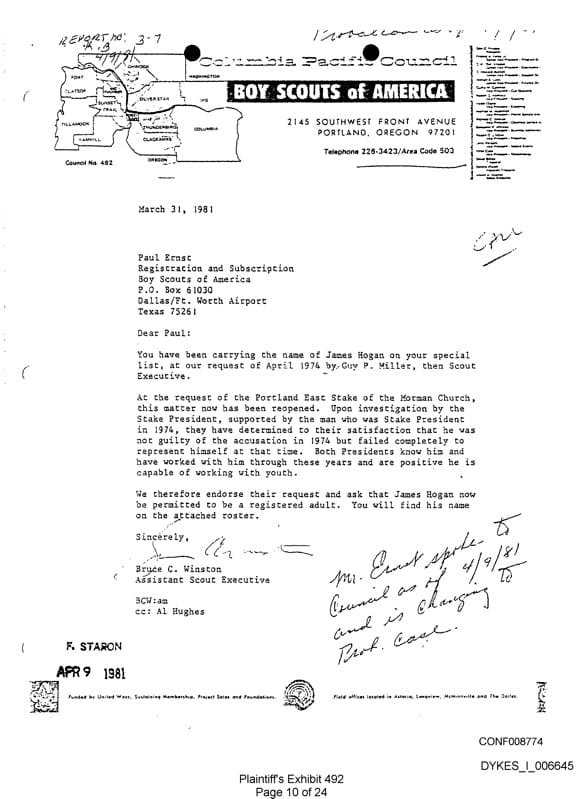
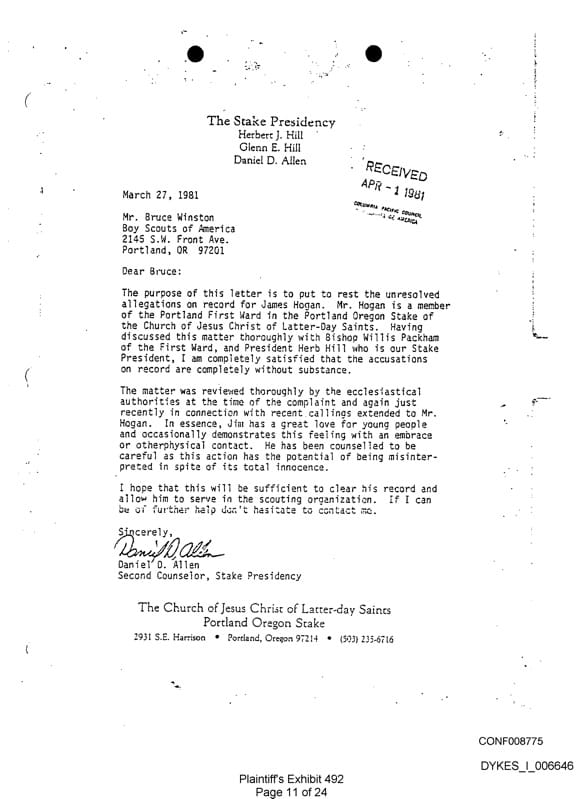
1981 Letter – BSA – Mormon church – James Francis Hogan – Jim – 1
On March 27, 1981, Daniel D. Allen, second counselor in the Portland Oregon stake presidency, wrote to Assistant Scout Executive Bruce C. Winston (emphasis ours):
Dear Bruce:
The purpose of this letter is to put to rest the unresolved allegations on record for James Hogan. Mr. Hogan is a member of the Portland First Ward in the Portland Oregon Stake of the Church of Jesus Christ of Latter-Day Saints. Having discussed this matter thoroughly with Bishop Willis Packham of the First Ward, and President Herb Hill who is our Stake President, I am completely satisfied that the accusations on record are completely without substance.
The matter was reviewed thoroughly by the ecclesiastical authorities at the time of the complaint and again just recently in connection with recent callings extended to Mr. Hogan. In essence, Jim has a great love for young people and occasionally demonstrates this feeling with an embrace or other physical contact. He has been counselled to be careful as this action has the potential of being misinterpreted in spite of its total innocence.
I hope that this will be sufficient to clear his record and allow him to serve in the scouting organization. If I can be of further help don’t hesitate to contact me.
Packham was familiar with the protection of children; his 2021 obituary says he “fostered 100 children.” He was also a career educator. In 1972, an Oregon Journal article referred to Packham as a “past president of the independent Portland High School Teacher’s Association,” which he said had 250 to 300 members.
Hill, a World War II Army veteran, went on to become president of the Connecticut Hartford Mission, per his 2017 obituary.
“Both Presidents […] are positive he is capable of working with youth”
1981 Letter – BSA – Mormon church – James Francis Hogan – Jim – 2
Four days later, Winston wrote to Paul Ernst (emphasis ours):
At the request of the Portland East Stake of the Morman [sic] Church, this matter now has been reopened. Upon investigation by the Stake President, supported by the man who was Stake President in 1974, they have determined to their satisfaction that he was not guilty of the accusation in 1974 but failed completely to represent himself at that time. Both Presidents know him and have worked with him through these years and are positive he is capable of working with youth. We therefore endorse their request and ask that James Hogan now be permitted to be a registered adult. You will find his name on the attached roster.
Ernst approved Hogan’s registration, keeping him on BSA probation but allowing him to work closely with boys once more.
A May 15, 1984 follow-up letter to Ernst from a Portland-area Scout executive states:
James F. Hogan served his L.D.S. sponsored Cub Scout Pack for a year and a half. His performance was satisfactory. He has since been replaced by the church and has left his position in good standing.
Once again, we wish the story ended there.
“REFUSE – TAKE OFF PROBATION – LAWSUIT AGAINST LDS CHURCH”
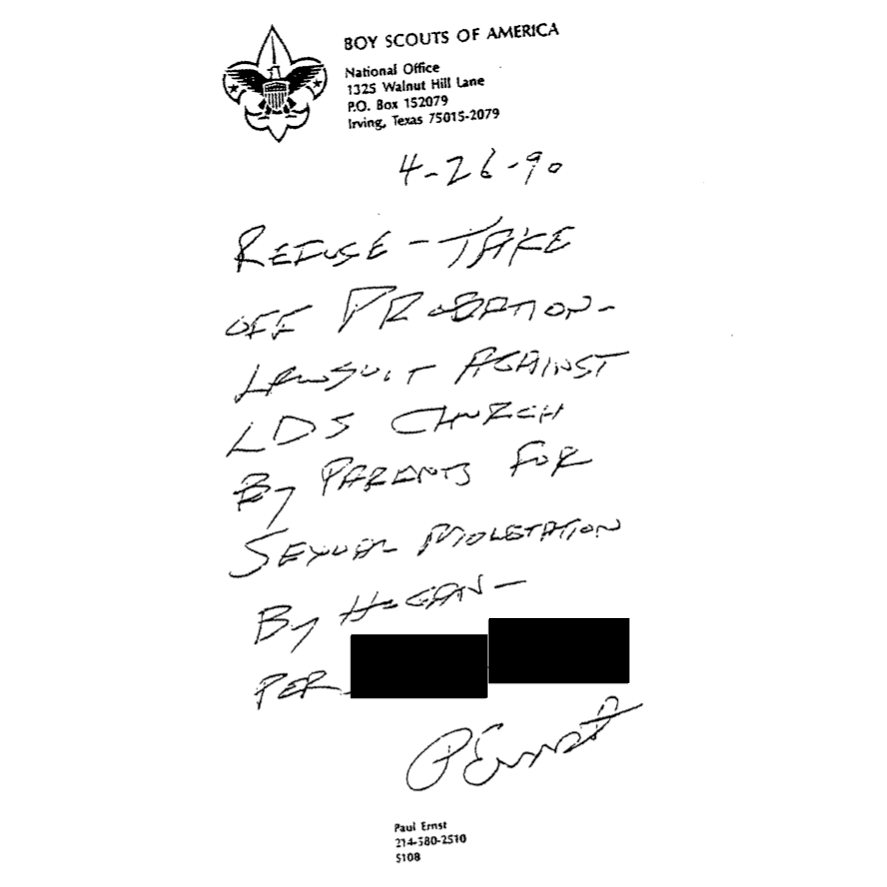
1990 BSA – Mormon church – James Francis Hogan – Jim – Paul Ernst note
That’s the start of a note in large handwriting by Ernst, inserted into Jim Hogan’s perversion file. It is dated April 26, 1990.
Ernst’s full note, written in all capital letters, reads:
4-26-90 – Refuse – Take off probation – Lawsuit against LDS church by parents for sexual molestation by Hogan – per [redacted] – P Ernst
Ernst, the BSA and the Mormon church had all failed multiple boys.
Mormon priesthood leaders in positions of authority, including a bishop, a stake president, a former stake president, and a stake presidency counselor, had insisted that Hogan was qualified to work with children, despite having received multiple reports of abuse in two U.S. states over a 14-year period, and despite Hogan’s status for seven years as an ineligible BSA volunteer.
In all, Floodlit has documented at least seven lawsuits against the church regarding abuse by Hogan: four in 1989, one in 2002, and two in 2008.
The church managed to settle yet another claim in or before 2011 outside of court; the alleged victim sued the BSA in 2011. Church defense attorney Stephen English told the Oregonian:
While the church always and absolutely condemns child abuse—and its heart and prayers go out to any victim of child abuse—our understanding is the church is not a defendant in this case.
The article omitted mention of the 2002 and 2008 lawsuits. English certainly knew about them, as he defended the church in all three.
For some reason, no acknowledgement of this fact made the news.
We are investigating further.
When was Jim Hogan actually excommunicated?
Floodlit also uncovered a startling discrepancy.

1989 news article on lawsuits v. Mormon church and Jim Hogan
When the first wave of lawsuits hit the church in 1989 over alleged abuse by Hogan, church attorney Allen Swan told a newspaper that Hogan was excommunicated in 1985.
However, Hogan himself told a newspaper in 2002 that the Mormon church excommunicated him in 1988. Criminal charges were filed against Hogan in December of that year.
It is easy to believe Swan over Hogan. By 1989, Swan had been a Regional Representative of the Quorum of the Twelve Apostles and president of the Australia Adelaide Mission. He defended the church, along with other clients, over a 39-year legal career.
Swan’s 2016 obituary says, “He devoted the final 15 years of his career to the firm of Kirton McConkie, his work focusing on representation of Intermountain Health Care and the LDS Church.”
However, if the church excommunicated Hogan in 1985, as Swan claimed, then how could abuse have possibly lasted until at least 1988, as the 2011 lawsuit alleged?
The plaintiff in that case was a former Cub Scout who said Hogan abused him for eight years beginning in 1981. One contemporary news article says “eight years,” while another says “1981 to 1988.”
Regardless of the answer, we have found no records to suggest that church officials told police when they excommunicated Hogan.
Floodlit is raising funds to help us obtain Oregon court records related to Hogan and Dyer, which would help us answer burning questions and continue to shine more light on the history of sexual abuse in the Mormon church.
Please consider donating if you can!
Echoes in 2025: The Maryland Lawsuit, and an abuser’s “180 degree shift”
Despite Silverstein’s 2022 rejection of its $250 million proposal, the church renewed its tactics in 2024 when victim John Doe sued in Maryland, alleging bishops and stake presidents repeatedly failed to address sexual abuse by Richard Kent James, as introduced earlier in this report.
Richard Kent James case report
Floodlit obtained a transcript of James’s guilty plea hearing, which was held Feb. 20, 2002 in Montgomery County Circuit Court.
According to a state prosecutor, investigators interviewed James at his home on May 25, 2001. He told them, “I met the boy in church when he was 12 years old.”
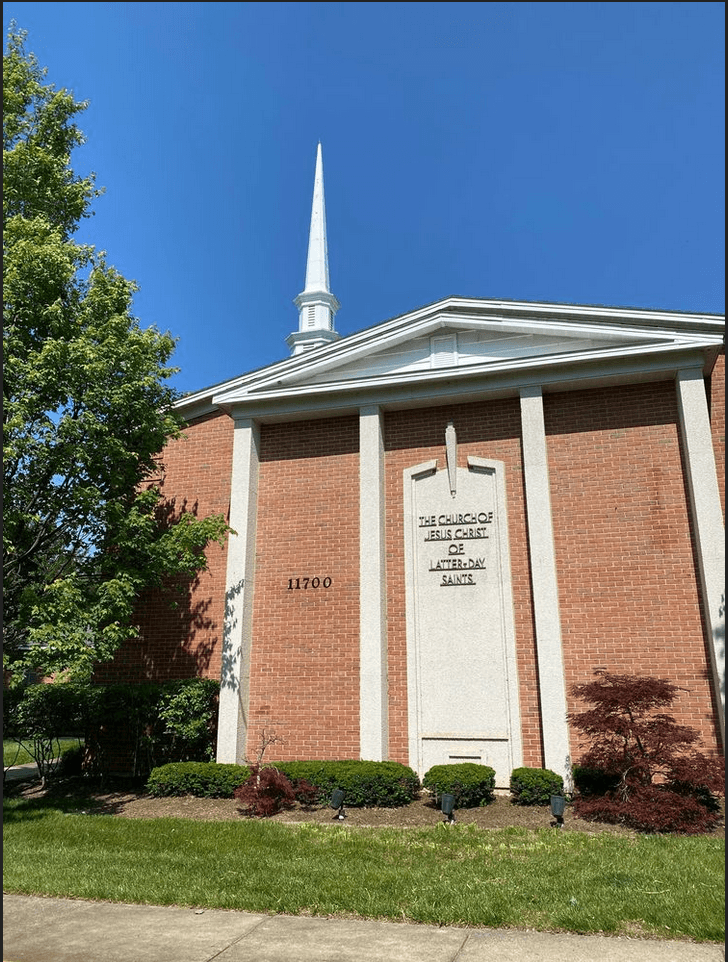
Latter-day Saint church in Potomac, Maryland
Floodlit also obtained a transcript of James’s sentencing hearing, held May 8, 2002.
After noting the “many, many letters” of support for James, his attorney, Deane Shure, told the court regarding James’s sexual abuse of Doe:
It did not happen on scouting activities. We’re admitting it happened in cars. We’re admitting it happened in activities outside of scouting, but we’re not admitting that it happened in scouting because it did not.
Doe, on the other hand, told Maryland police in 2001 that the first incident of sexual abuse took place in early 1995 at billionaire hotel magnate Bill Marriott’s home, while James was house-sitting. At the time, Doe was 12 and James was his Mormon young men’s leader – but not his Scout leader yet. That began months later, Doe said.
Doe’s 2001 police report detailed abuse at Marriott’s home, church events, and Scout trips. Two bishops dismissed him; one stated: “There’s not enough evidence […] You need to repent” (per lawsuit). That bishop did not conduct any investigation into Doe’s allegations, according to the lawsuit.
In a July 14, 2025 deposition, James completely reversed his 2002 account, saying, “I wouldn’t have known [Doe] if not for scouting.”
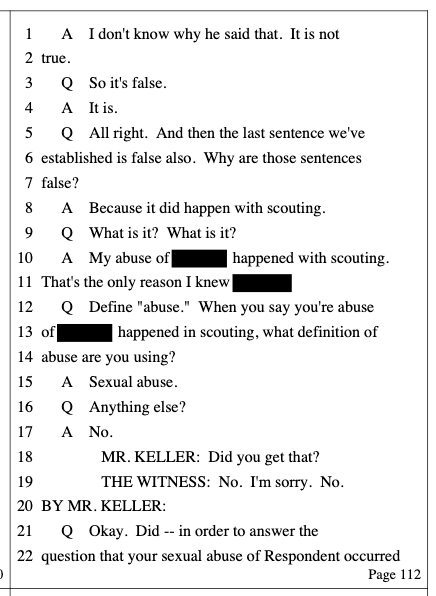
2025 Richard Kent James deposition
Doe’s attorneys wrote, “The 180 degree shift between James’s position in 2001 and 2002 and James’s position today is astonishing. […] That switch is inexplicable – yet must surely be welcome news to the Church.”
Doe’s attorneys also accused the church of omitting 19 pages of James’s BSA perversion file even as it attached over 900 pages of other material to its motion to try to force Doe to dismiss his lawsuit. They wrote (emphasis ours):
[T]he [church’s] Motion to Enforce purports to include a copy of James’s [perversion file], but the document it attaches is just a single page. The full, 20-page perversion file (which the Church unquestionably has) includes police and court charging documents and contemporaneous news reports.
The missing 19 pages, they said, revealed that James’s abuse of Doe preceded their Scouting relationship and lasted long after it.
Describing the nature of Doe’s claim, which they called “a quintessential ‘Mixed Claim'”, Doe’s attorneys wrote:
A Venn diagram here would not be two circles with only portions that overlap and each with non-overlapping portions. Rather, it would be one circle (Scouting) completely subsumed by a much larger circle (Church).
Maryland Lawsuit: Latest Updates
On Aug. 12, the church filed a reply insisting, “The entirety of the Abuse has a Scouting connection and is therefore channeled and released pursuant to the Plan and Confirmation Order.” (emphasis in original)
As of Nov. 4, 2025, the bankruptcy court has not yet ruled on the matter. Floodlit will continue to provide updates.
An avalanche of “mixed” abuse
Floodlit has identified dozens of cases fitting the criteria for what the BSA bankruptcy proceedings termed “mixed claims,” where a Mormon Scout leader was accused of abuse both in and out of Scouting. The church’s $250 million proposal would potentially have released it from liability in such cases.
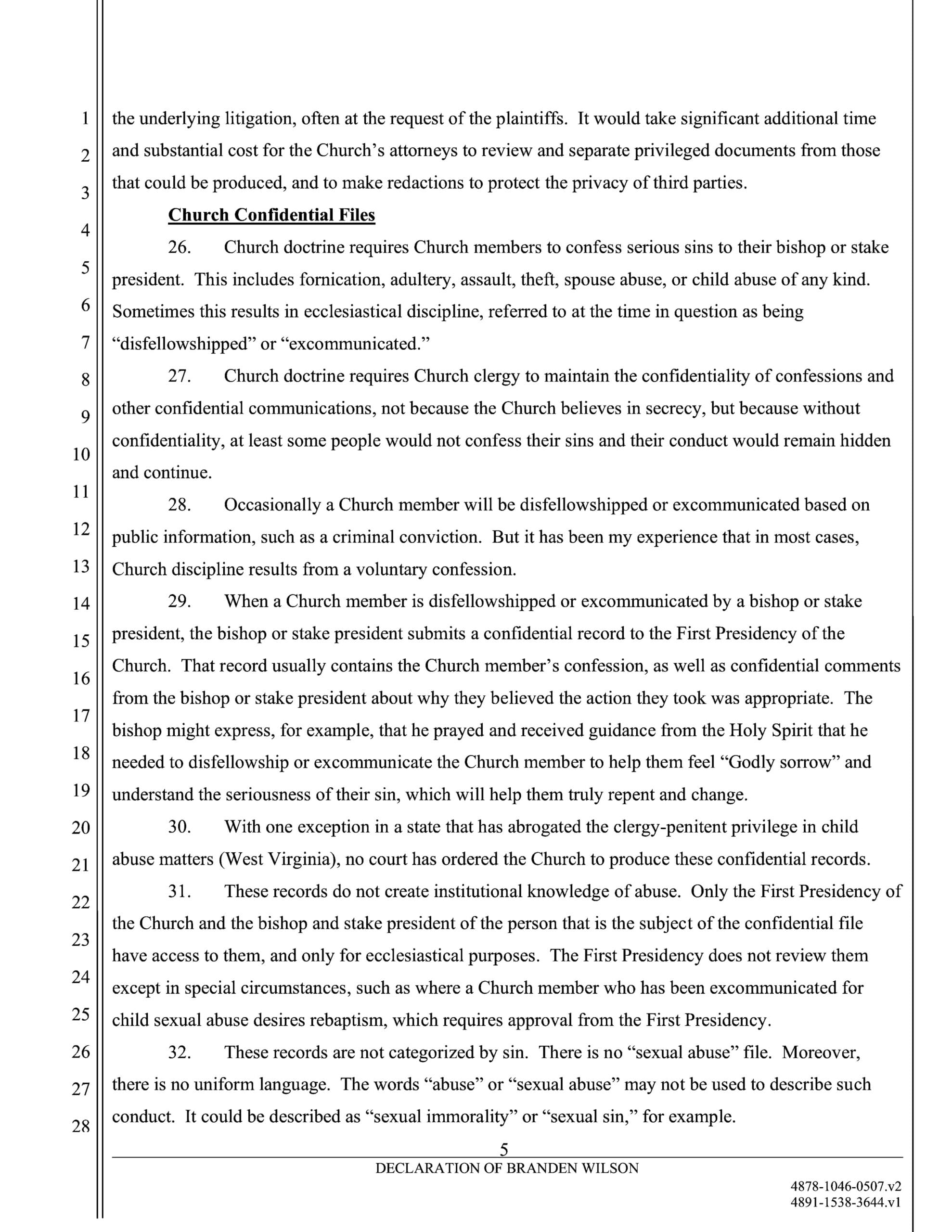
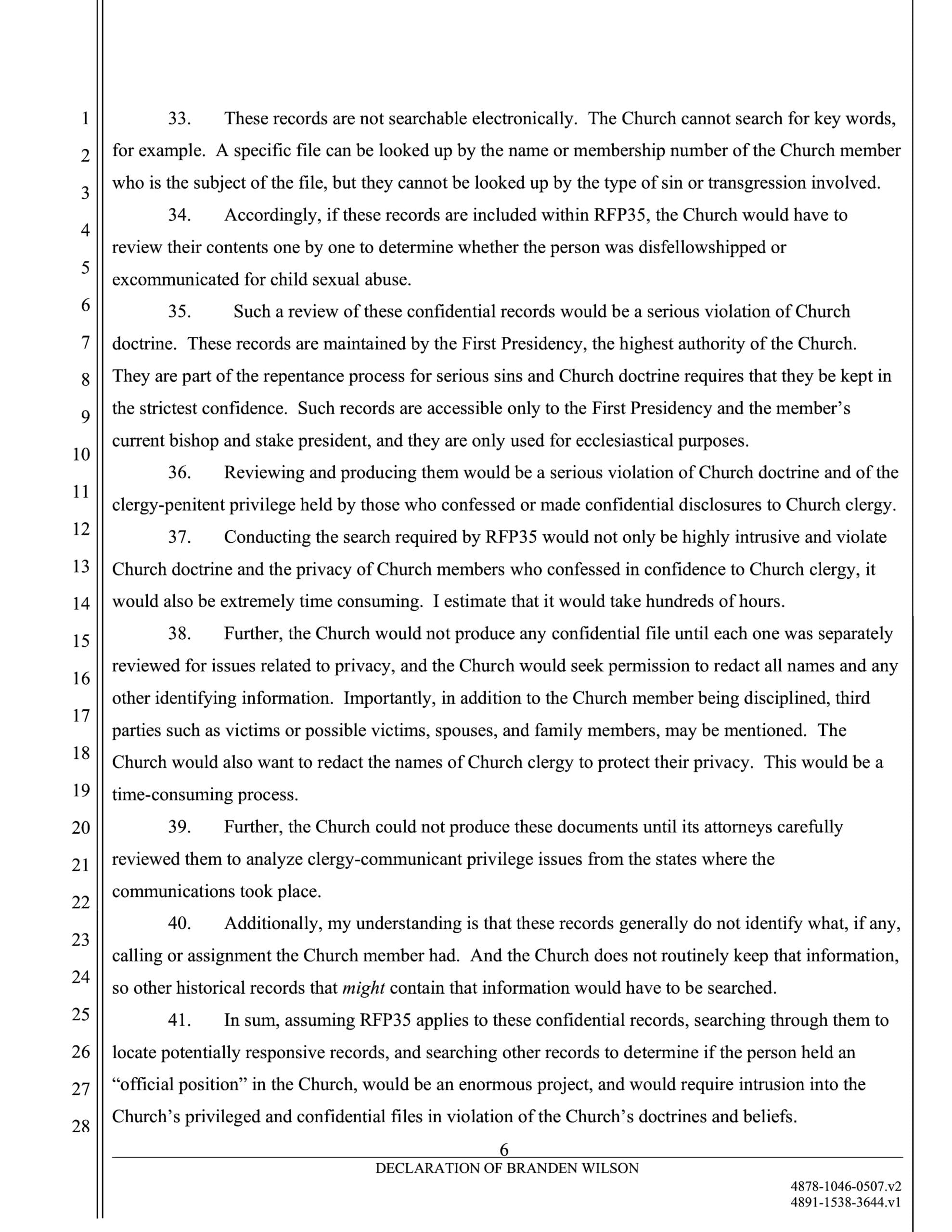
We would likely be able to list more, but for decades, the church has resisted legal efforts to compel it to divulge disciplinary records or share internal data regarding alleged sexual abusers.
However, in an upcoming report, we’ll show you that, in relation to those efforts, the church recently experienced something it said it never has before.
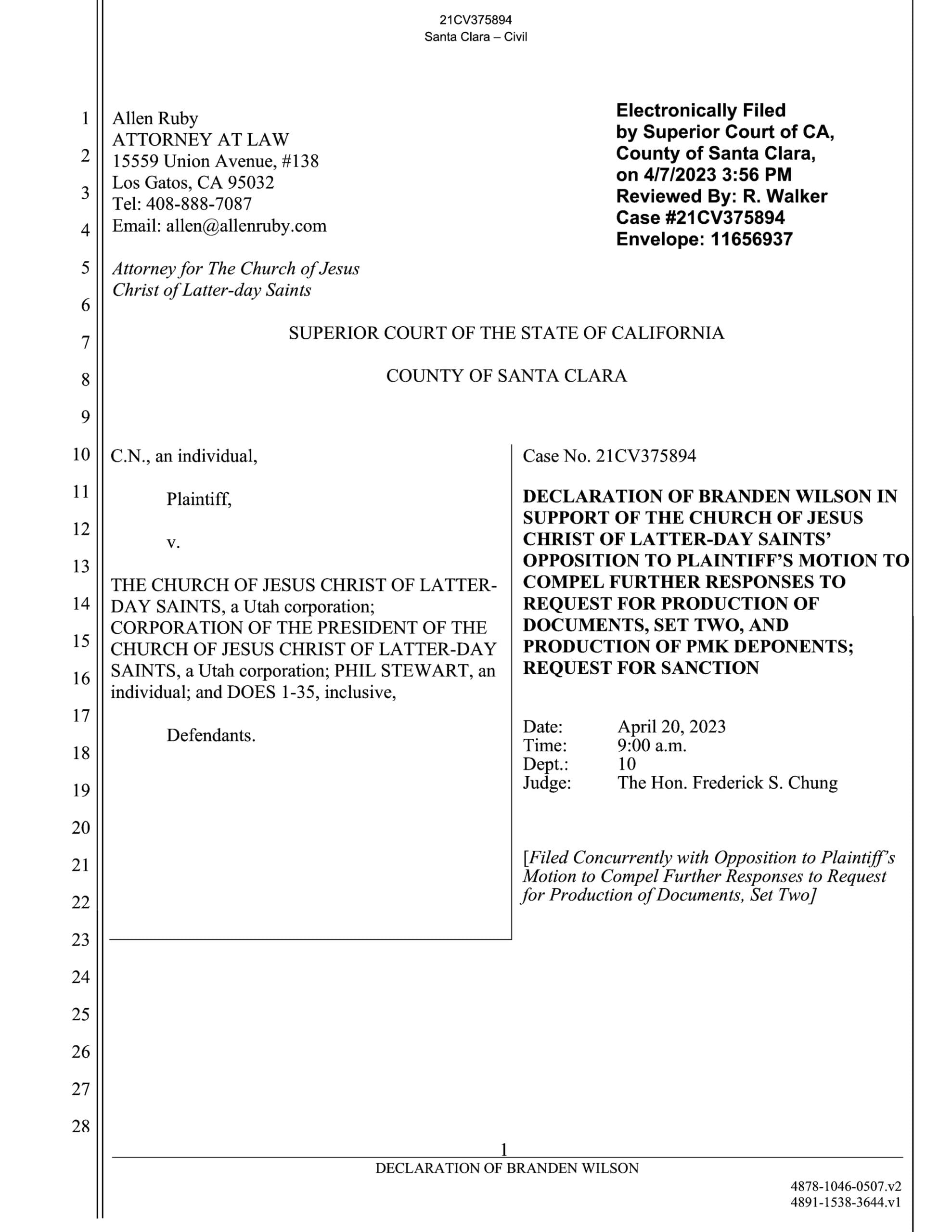
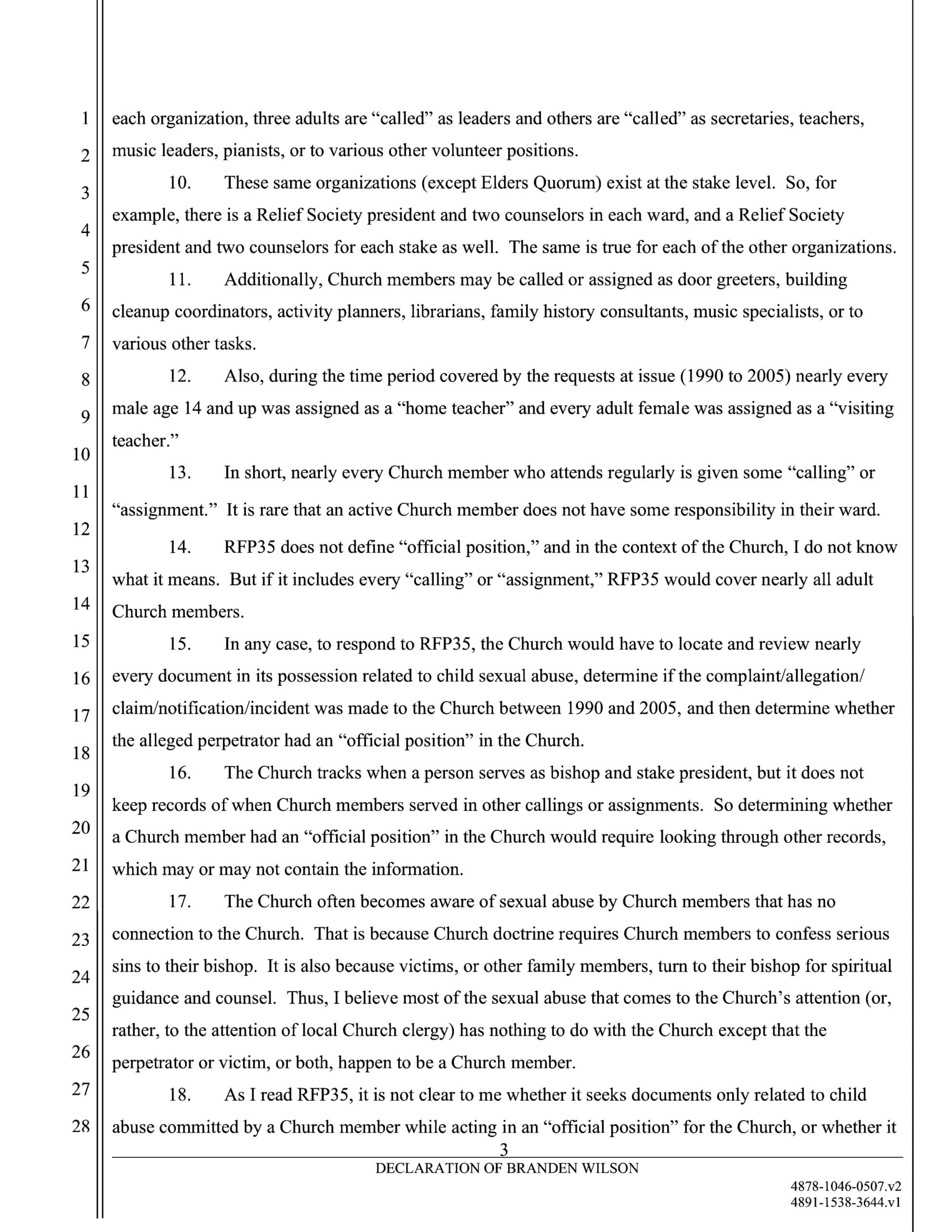
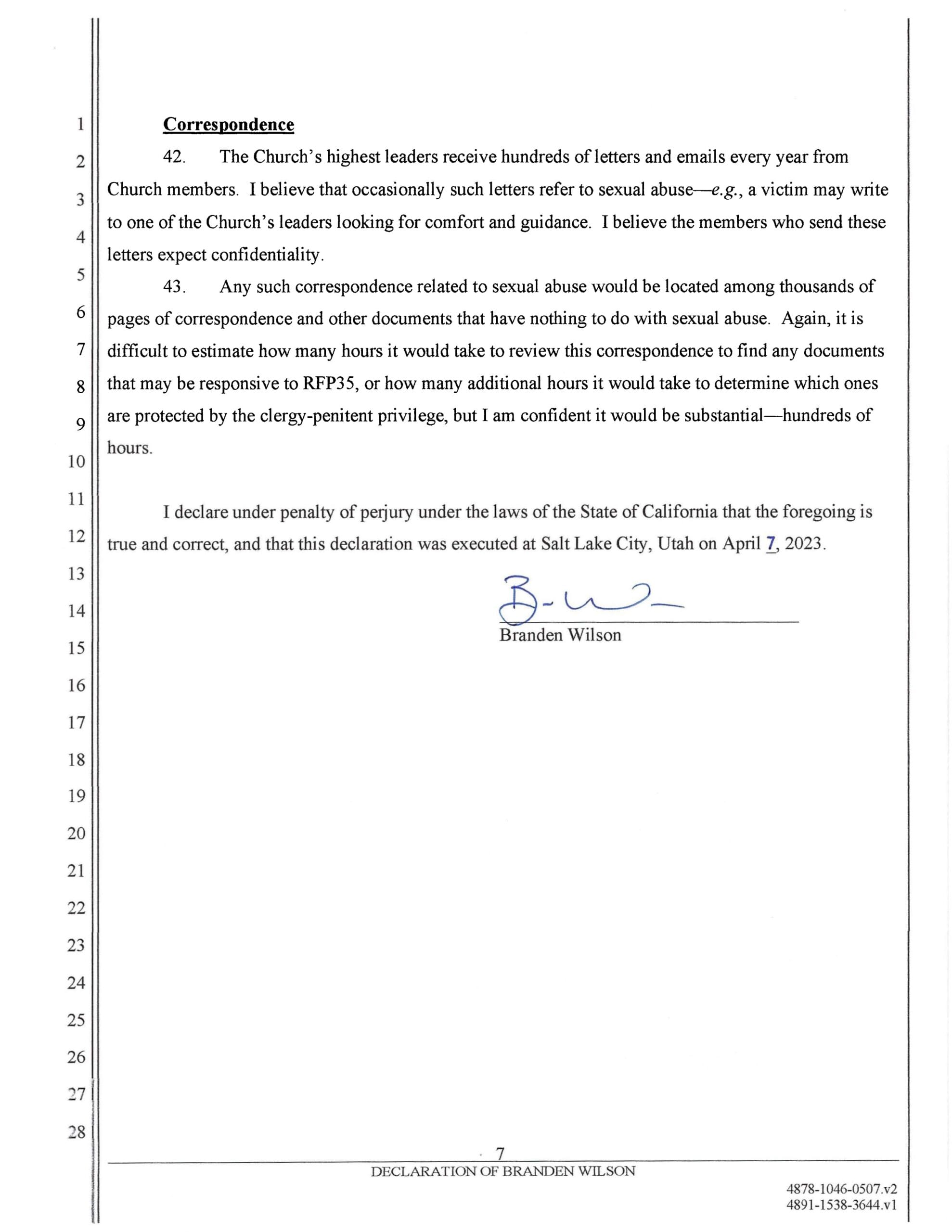
In 2022 or 2023, Branden Wilson replaced Paul Rytting as the church’s director of risk management. In a 2023 declaration filed during a lawsuit, Wilson stated that “there is no ‘sexual abuse’ file.”
-
- LDS church risk manager Branden Wilson declaration, April 7, 2023, page 1
-
- LDS church risk manager Branden Wilson declaration, April 7, 2023, page 2

-
- LDS church risk manager Branden Wilson declaration, April 7, 2023, page 3
-
- LDS church risk manager Branden Wilson declaration, April 7, 2023, page 4

-
- LDS church risk manager Branden Wilson declaration, April 7, 2023, page 5
-
- LDS church risk manager Branden Wilson declaration, April 7, 2023, page 6
-
- LDS church risk manager Branden Wilson declaration, April 7, 2023, page 7
Further reading:
Latter-day Saints church statements about abuse prevention and handling:
- Church Offers Statement on Help Line and Abuse – Aug. 5, 2022
- How the Church Approaches Abuse – accessed Nov. 6, 2025
Where do we go from here?
In the end, the church’s proposed $250 million payment to the BSA’s abuse settlement fund, rejected during the BSA’s bankruptcy proceedings, represents a significant financial acknowledgment of liability for abuse occurring within church-sponsored Scouting programs.
It also underscores the church’s historical entanglement with Scouting activities and the enduring costs of insufficient oversight.
Nevertheless, as Floodlit has learned while researching decades-old abuse cases as well as ongoing lawsuits, the evolution of abuse prevention and handling in the church continues to surface in significant litigation.
Indeed, there are so many “mixed claim” cases in Floodlit’s database that we would not be surprised to find more reports of such disputes – especially if Judge Silverstein denies the church’s motion and allows John Doe’s Maryland lawsuit to proceed.
For the sake of the vulnerable and survivors, we plan to continue to shine a light on this topic.
Floodlit’s next report examines what church officials knew, and when, about the prevalence of sexual abuse in the church.
We found information about former church attorneys that we want you to know.
In the meantime, Floodlit will continue our reporting and make more court filings publicly accessible to foster accountability.
We will also keep you informed about over 200 ongoing abuse-related civil lawsuits and criminal cases involving the church or its members.
We rely on your support! Please consider donating to help us expand our records.
Thank you!
Thank you to the survivors and others who shared valuable insights through interviews. Thank you so much to everyone who has donated to support us. It has made such a huge difference for so many people.
And thank you for reading and considering and sharing this content. We hope you find it helpful.
Feedback/suggestions?
Are you an abuse survivor?
The abuse was not your fault. You are not alone.
Floodlit has information about resources that may help.
Report sexual abuse by a Latter-day Saint

You can report a Latter-day Saint sexual abuser to Floodlit, even if the perpetrator never faced justice or the abuse took place long ago.