LDS positions: Unknown position,
 - LDS mission:
 no
no - Alleged:
5 victims, Multiple victims,
- Alleged crime scenes:
Unknown crime scene,
 Criminal case(s): Convicted, Plea deal, Pleaded guilty, Prison,
 - Civil case(s): Judgment for plaintiff, Lawsuit v. LDS church,
- Alleged failure to report
-
Church paid $4,000,000
- AKA Chuck Blome
 updated Feb 26, 2026 - request update | add info
 Crime:
  Crime state:
 LDS positions:

 Alleged:
 Alleged crime scenes:
 Criminal case(s):

A jury found that four former LDS bishops failed to protect a child victim from being abused by Blome. At the time Blome’s crimes were revealed his Mormon bishop notified him that he was a suspect. Blome was thereby able to destroy evidence that may have led to a longer prison term.
—
LDS church found liable for $4 million
10/08/83 Texas
LDS BLOME-Charles John “Chuck” Blome “a 60-year-old retired Army officer, is known
to have molested at least five boys from the Magnolia church and is being sued along with
the church. He pleaded guilty in 1994 to two counts of indecency with a child and is serving
two concurrent, 15-year prison terms.”
“Former bishop denies he knew molester’s past” by PAUL McKAY
WED 09/30/1998 Houston Chronicle, Section A, Page 21MetFront, 3 STAR Edition
“Last year in Montgomery County, a jury found the national church liable in a $4 million
verdict – $1 million more than the plaintiff had sought – for failing to protect an 8-year-old boy
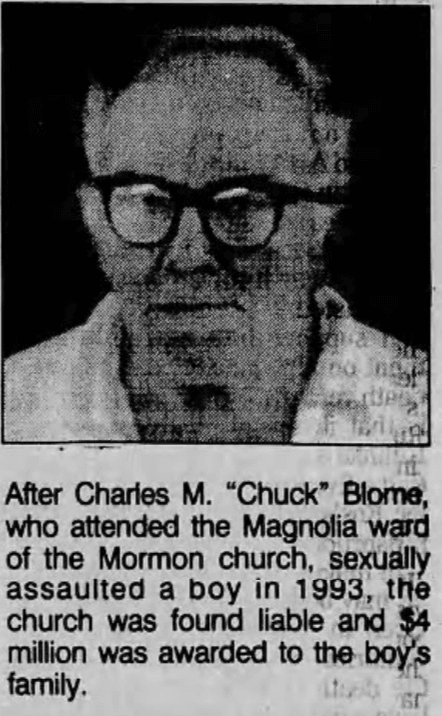
who was sexually assaulted in 1993. The pedophile, Charles M. “Chuck” Blome, who
already had been convicted of criminal charges and sentenced to prison before the lawsuit
trial, was active in the Magnolia ward that the child and his mother attended.””
“The church will go to great lengths to protect its image and reputation,” said Clay Dugas, a
lawyer in Orange who has sued the church on behalf of numerous child-abuse victims and
their families in Texas and Mississippi.”
“A pedophile will have all kinds of opportunities to go into the homes of members or have
easy access to children so he can build trust with the kids and families,” Dugas said.
“Men are empowered in the church very quickly. Females don’t get that empowerment. The
men have all the real authority. The church is very patriarchal, very secretive. Why would
you preach to the membership of a church not to discuss a case of child abuse when it
becomes known? They do that. The whole belief is that the men, the leaders who are all
men, can take care of everything. If someone in a family is abused, the family won’t go to
the police. They’ll go to the bishop.”
“The church is appealing that verdict and is fighting other, similar lawsuits in which Mormon
representatives are accused of shunning young victims or, in some cases, even blaming
them.” “Sheriffs deputies were upset that the Mormon Bishop tipped Blome to the pending
investigation, and he burned evidence before it could be seized. In an earlier case against
Blome the Mormon Church was also found negligent.”
“Former Bishop Jerry Torgeson alerted Blome that he was under suspicion only two days
after the boy’s family alerted him of the abuse.” “Blome also molested at least four other
boys from 1982 until his arrest in 1994.”
Have any info on this Mormon sex abuse case? Contact us.
Sources
- Blame the Victim: Hushing Mormon Sexual Abuse ,
- Mormons caught up in wave of pedophile accusations,
- John Charles Blome/ Mormon Court Case Overviews,
- Jury awards abused boy $4 million from LDS Church,
-
1. Blame the Victim: Hushing Mormon Sexual Abuse
Marion Smith, founder of the Intermountain Specialized Abuse Treatment Center, and a longtime chronicler of child sexual abuse, in the shadow of the LDS Church Office Building. Answers to her questions about abuse cover-up are not forthcoming.
With terror, James Adams confessed sexually abusing his two young children to his LDS bishop, stake president and other men in his Beckley, W. V. ward. The children's mother was in Alaska; he had custody of the children. His bishop did not report Adams' abuse to law enforcement. Nothing was done to help or protect the children.
The abuse was sadistic and frequent, and it continued for five more years until the children's mother and state police learned of a 55-minute video tape that Adams made of his molestation of his own children.
A $750 million lawsuit was filed on Jan. 16, 1996 in West Virginia, charging the Church of Jesus Christ of Latter-day Saints with negligence in reporting child sexual abuse in this case. The lawsuit names as defendants five church officials in Salt Lake City, including President Gordon B. Hinckley. Adams pleaded guilty to 37 counts of child sexual abuse and was sentenced to serve 75 years in prison.
As the highest profile case of child sexual abuse and the largest claim for monetary damages brought against the LDS Church, the resulting court battle could have far reaching ramifications for church officials and for how such abusive situations are handled in the future. While abuse has recently been condemned from the pulpit by some church authorities, individual cases are often hushed up, as officials act instinctively to protect the church's reputation first and victims only as an after-thought, resulting in a new round of secondary abuse.
The case brings national focus to an issue that only recently has been acknowledged and previously minimized or dismissed among Mormons. Child advocates say that child sexual abuse exists in LDS congregations in Utah and across the country. A year and a half ago, Lisa Davis, a Phoenix newspaper reporter noted "at least thirty-five recent instances of molestation involving the Mormon Church," recorded in "national news and legal databases" ("Latter- day Sinners," New Times, December, 1994).
Case Study in Coverup
A high profile incident in Oklahoma is a case study in cover-up. For Merradyth McCallister and Mary Plourde of Oklahoma City, Okla., their efforts to expose the child sexual abuse problem in their local Mormon congregation not only resulted in cover-up, they were ecclesiastically punished for their pains.
In September 1993, Merradyth and Jack McCallister and their son Scott of Yukon, Okla. told their stake president that Scott had been sexually abused by their bishop, Ronald Phelps. The stake president discounted and minimized Scott's abuse which had occurred over a two year period. Having learned from speaking with other families that Phelps had also abused other children in the ward, the McCallisters formed a support group for survivors of sexual abuse.
The McCallisters told "The Event" that the stake president then informed them they had "crucified an innocent man and destroyed his family," had "slandered Phelps," and that the children's word could not be believed over that of a priesthood leader." They were advised not to pursue the issue.
Public Indecency
The McCallisters did a background check on Phelps and found that he had been arrested for indecent exposure prior to being called as bishop in 1980. He had also been charged with sexual abuse but not prosecuted; this charge was known to the stake leadership when Phelps was called to serve as bishop. On March 8, 1994, Phelps was again arrested in a men's rest room at Oklahoma University for investigation of public indecency and soliciting to commit an act of lewdness. The stake president then informed the McCallisters that the arrest had nothing to do with sexual abuse allegations. Phelps continued to serve in church positions.
The McCallisters continued to warn others that Phelps was a predator. They wrote to President Gordon B. Hinckley (a First Presidency counselor at that time), detailing these events and asking him to intervene. They heard nothing. When they went to the local media with the problem they were punished by their church leaders. In August 1994, Merradyth was excommunicated from the LDS Church for "conduct unbecoming a member of the Church" and for "actions which have not only affected the good name of the Church but also the good names, lives and testimonies of the members."
Jack resigned his Church membership in protest. Mary Plourde, a family friend who worked on this case with the McCallisters was also excommunicated that same month, for the same reasons. Plourde and Merradyth reported they were refused copies of their excommunication notices, after being allowed to briefly see them and hear them read aloud by the bishop. They said the documents were signed by Gordon B. Hinckley. They have since taken their crusade to Oklahoma City detectives and prosecutors.
Pervasiveness of Abuse
Statistics from the Boy Scouts of America and the National Committee for the Prevention of Child Abuse indicate one in four girls and one in six boys will be sexually abused before they reach the age of 18. These statistics apply to all large populations. Despite public emphasis on family values, child abuse still invades Mormon families; one in four Mormon girls and one in six Mormon boys will be sexually abused by age 18.
Child abuse is disruptive to the individual and society. Its primary effect is shame and self-blame in the child's mind. A child is physically helpless and emotionally dependent. So the child's effort to gain control becomes a central issue. A child abuse victim seeks control in one of two ways: through self-blame, becoming a victim and re-enacting self abuse through multiple symptoms; or, by identifying with the abuser's power and reenacting the abuse upon someone else. There is no way to assess the full cost of child abuse to the individual and society.
It is typical for abuse survivors to be in their 30s or 40s before they finally are able to start to deal with past abuse. Usually a survivor requires therapy for four to five years. The costs of therapy vary greatly, but $75 per hour is an average fee.
Sometimes, one generation of abuse shows up in particularly egregious violence in the next. Among the most notorious historical villains of the 20th century, Adolf Hitler, Saddam Hussein, and Romanian dictator Ceausescu were all brutally abused as children.
With the LDS Church awash in negative publicity regarding child sexual abuse in the past decade, church leaders have begun to speak publicly about the problem, General Conference speeches have condemned it, educational materials have been prepared, training sessions have been held, Boy Scout leaders are instructed now to send more than on adult chaperon with children on outings.
The "Bishop's Handbook"—a resource available only to male leadership—now states that a bishop must report abuse, unless the information came from a perpetrator during a confessional interview. Some bishops are more conscientious than others, child advocates observe. There are those willing to walk victims through the fallout of abuse. Others describe bishops who hinder the process.
Survival & Betrayal
Fourteen years ago, when I began practicing as a therapist in the field of child sexual abuse, I met adult victims of abuse who literally might not have survived if it had not been for the extraordinary support of compassionate bishops. At its best, the church system can work to help heal and improve individuals. However, when support is not given, and victims are disbelieved, blamed or are counseled not to pursue the matter, the individual is betrayed by his or her extended religious family in whom trust has been invested as freely as protective and nurturing parents.
From clients whose identities remain anonymous, I listened to stories of how their abuse was intertwined with their religious life and church leaders. John, a young man in his 20s, says "I was abused by my scout leader when I was 10. I tried to tell the bishop about it once. He asked me if I was gay. I never approached him again. I am no longer active in the church."
Jane is in her mid-40s. While working in the travel industry for many years, she was in therapy for abuse she suffered from her father and grandfather for years when she was young. While her father was abusing her [he] was also her bishop and was widely respected in the ward. "I used to look up at him when he stood at the pulpit and I thought he was God. It's still hard for me not to associate God and my father as one person, even after all these years of therapy."
A Provo woman, Elaine, reported that after years of struggling alone, telling no one about being sexually abused by her father, she finally went to the stake president, with whom her father had served on the regional high council. His response was that he did not see how he could possibly judge events between her and her father. He therefore had to assume that her father was "an honorable man" because he held a high church office. She must be wrong, she was told.
Jamie had suffered guilt and self-hatred all her life. Intensely religious, she says for years she tried to tell bishops and others in the church of her abuse but she was always told to forgive and get on with her life. "I would go to church and feel different from everyone else and totally unworthy. I couldn't ask for a temple recommend. I tried to fade into the background." Recently she has finally found ways to express and process her feelings about the abuse through the help of her current bishop whom she says is supportive and understanding of her needs.
Kate who grew up in Salt Lake City, was repeatedly abused by a ward member between ages 7 and 9. Her sisters were also abused by this man. No one came to their aid. Years later, Kate and her sisters entered therapy to deal with their abuse. One day when Kate's sister attended an LDS temple session, she was horrified to see their abuser serving as a temple worker.
She also learned that this man was serving as a volunteer with children at a local hospital. She called the hospital and reported him to personnel there. He was discontinued as a volunteer at the hospital. Kate and her sister wrote to this man's bishop and explained the situation. They were told that they should forgive and forget; the bishop took no action against the man.
Blame the Victim
In spite of current instructions in the "Bishop's Handbook" telling bishops to report sexual abuse, many Mormon clergy do not appear to understand the legal imperative for reporting. A member of a 13-year-old Holladay girl's family told me that the girl was sexually abused by a ward member in his 30s.
A church disciplinary court was called against the girl, accusing her of sexual activity, describing it as an "affair" with this man. Subsequently, she behaved promiscuously with boys her own age. Called to church court, the girl made a serious suicide attempt. This did not deter the stake president from proceeding with her church discipline.
Only when the girl's grandfather intervened by contacting child advocates who threatened public exposure of the case, did the stake president drop the church action against the girl. Unfortunately, by then the girl had been deeply damaged by both sexual and ecclesiastical abuse. Without the threat of public exposure, the girl would possibly have been excommunicated while her abuser went unpunished.
In Your Neighborhood
"From statistics available on child sexual abuse we know that it can and does happen in all neighborhoods, crossing all social, economic, ethnic and religious backgrounds," say Andrea Moore Emmett, Midvale, who encountered abuse in her neighborhood in the summer of 1993.
"If it hasn't already, it will happen in your neighborhood, to someone you know and care about; it may occur down the street or right under your own roof. Never mind the faceless statistics that say it's someone else's problem—now it's yours."
A young man in Emmett's LDS ward sexually abused neighborhood children in his mother's unlicensed day care. Knowledge of this abuse emerged later while he was serving an LDS mission; he was sent home. Emmett's children did not visit the day care and escaped the abuse, but other children were not so lucky. More than 14 neighborhood children were interviewed by a detective and found to have been abused by the young man at the day care over a period of several years. Charges were filed, but plea bargaining lowered time served to two weeks in the county jail since his case was considered "a first offense." He was then placed on one year's probation by the court.
A friend living across the street from Emmett discovered that her child had been abused. When this mother pressed the bishop for help and therapy for her child, she was denied response or assistance from the church. She and her family soon moved from the neighborhood. "The bishop showed no concern for the children's plight; and he treated my friend as if she was a troublemaker," Emmett says. The young man was "disfellowshipped" (a punishment short of excommunication), but given support, therapy, a job and other assistance from the church.
Emmett resigned her church membership shortly afterward, saying "I was already disillusioned with the way the church treats women, but after this, I could no longer support the church as a member."
Abuse Helpline
In May 1995, under pressure from increased publicity and mounting legal problems, the LDS Church announced a toll-free phone number for reporting child abuse directly to church headquarters, 1-800- 453-3860, ext. 1911. Some church members are encouraged by the helpline and express enthusiasm about having access to church headquarters for reporting child abuse problems. Others are less optimistic. The number is not for general use. Calls are accepted only from bishops or stake presidents.
"The impression [given from Mormon members here] is to refer problems to the bishop and let him call the 800 number," says an anonymous Midwest Mormon woman. "We have learned first hand that it is foolish to leave this matter to be dealt with internally— more often than not the accused is afforded more concern and protection than the person abused.
"[Those of us] in stake Primary, Relief Society and Young Women's presidencies wanted to find aggressive ways to provide support for victims and others, beyond the 800 number. We got permission to put together a stake training meeting for women leaders of Primary, Young Women and Relief Society concerning child abuse. With many of the men in the ward and stake leadership, we must battle the assumption that the story ends when abuse is reported. We contend that the reporting (and the 800 number) is only one chapter in the middle of a very long book."
Some Utah Mormons assert that the helpline diverts information to church headquarters, where it is more effectively buried or covered-up.
Speaking Out
When children are sexually abused by church members, then abused again with acts of denial and cover-up by their ecclesiastical leaders, it creates a double betrayal. Some Mormons who've experienced both sexual and ecclesiastical abuse have come to believe that only by speaking out and making their stories publicly known can such abuses be avoided in the future.
The Mormon Alliance—an independent organization that identifies and documents cases of ecclesiastical abuse in the LDS Church—will publish in May its "Case Reports" of abuse (including sexual). Ecclesiastical abuse is defined as any type of coercion, repression or silencing of church members by church leaders. The Alliance has collected dozens of child sexual abuse cases in which ecclesiastical leaders have been negligent in reporting abuse or punitive to those who point it out.
For example, a Calgary woman reported that in 1993, "An LDS psychologist specializing in treatment of LDS women who had experienced sexual abuse was excommunicated for "destroying families and disobeying the priesthood [i.e., taking his patients' stories seriously]. Several women under his care now no longer pursue church channels to have their cases dealt with."
Mormon Alliance trustee Lavina Fielding Anderson, editor of the forthcoming "Case Reports," documents 23 cases of criminal prosecution for child sexual abuse by Mormons. "Nothing in church policy or doctrine provides the slightest justification for child sexual abuse," she says. "That's why it is such a shattering betrayal of trust when an ecclesiastical officer chooses to put the well-being of the perpetrator ahead of the well-being of a child."
In addition to documenting abuses, "the Mormon Alliance works to promote healing and closure for abuse survivors, to build more sensitive church leadership, to empower LDS members, and to foster a healthier religious community," Anderson adds. The Alliance believes that when child sexual abuse occurs among members of a church congregation, the result is enormous personal and legal problems. It damages individuals, families, the institutional church, as well as the Mormon community and surrounding communities.
More Hard Cases
Take the case of LDS attorney Michael Shean in Santa Maria, Calif., and LDS seminary teacher convicted of sexually abusing young boys. Court records in a civil suit against the LDS Church allege gross negligence on the part of ward leaders who knew Shean had problems—as a counselor in his ward bishopric, he had been excommunicated for abuse of two young boys that surfaced years later when they were on LDS missions. He was excommunicated, re- baptized and assigned to work with youths.
Or the case in Magnolia, Texas, where Charles Hohn Blome, a 66- year old Mormon high priest, was charged and found guilty of aggravated sexual assault and indecency with a child. Legal charges allege that his church leaders knew of Blome's pedophilia and covered-up critical evidence about his sexual abuse of children in the ward.
In 1995, a Salt Lake child advocate reported to me that a 15-year old boy was sent by LDS Social Services to live in the home of a southern Utah bishop. Not long after moving in, the boy sexually abused the bishop's children. Social Services personnel knew that the boy had a history of sexually abusing children, but they did not warn the bishop of this problem. They simply said the boy was "troubled" and "needed a good environment." By accepting this call to care for a church member in need, the bishop and his family were devastated.
Follow the Leader
Or take Kris Morton's story. Morton was raised in a devoted Mormon family with a strong pioneer heritage. Her father was a high priest and their lives were centered around the church. She was sexually abused at various times during her childhood by family members. One was her great uncle, who served as a branch president in Utah. At night he would come to her room and sexually abuse her, telling her that he was "helping her," doing her "a favor." She says, "I tried to defend myself but I was no match for him in that situation and he knew it." Morton suffered alone, never telling anyone.
"In church they told us young women to be morally pure; they warned us about young men our age trying to take sexual advantage of us, but they didn't warn us about our priesthood leaders or family members trying to do the same thing. They told us to honor male priesthood holders because they act for God on earth. They told us to follow our leaders and do what we were told and everything would be all right. Well, it wasn't all right, and I'm angry about that."
Finally, when Morton was 36 years old, she began to admit to herself the full realization of her abuse. She entered therapy and confronted her aunt with abuse by her uncle who had since died. Neither confirming nor denying the abuse, Morton's aunt said her uncle "was only human" and he "gave devoted service for so many years the Lord had forgiven him his sins." She blamed Morton for bringing the abuse upon herself, and she accused her of trying to tear apart the family.
"My aunt was so supportive of her husband, she was compromised into denying the impact of sexual abuse," Morton says. "I needed her support, not her blame."
Loyalty vs. the Courts
The first lawsuit filed against an American clergyman for sexual abuse of a child occurred in 1984 ["Insurers Help Churches in Abuse Suits," Salt Lake Tribune, Oct. 15, 1994]. Loyalty to leaders may prevent most Mormons from seeking legal redress for child abuse. But continued lack of response to abuse, followed by denial or cover-up, are forcing some to seek action in civil courts.
Sometimes a lawsuit may be the only way to create responsibility. "I think we will see the Church change over time, largely because the lawsuits have forced the issue," says Sue McMurray, a Texas Mormon. Lisa Davis' "New Times" piece reported that child sexual abuse "has cost the [LDS] church millions of dollars—perhaps tens of millions—in liability lawsuits across the nation." And these were just the cases "that made it into the legal system."
The problem of increasing legal action against the church was reportedly addressed at a September, 1994 LDS Regional Priesthood Leadership meeting in Calgary, Canada. Two men who attended the meeting but asked not to be identified reported that Pres. Hinckley responded to questions about child sexual abuse, warning leaders that if they had "the least inkling that people have a problem with this . . . then they should be left out of church positions."
Hinckley instructed leaders to watch for and take action on cases of sexual abuse since these cases were "costing the church millions of dollars in lawyer's fees and settlements." Hinckley said, "It costs the church time and money to fight these things," and added that "the church is being sued for millions . . . we have more lawyers than we know what to do with."
The Catholic Model
Like the Catholic Church, the LDS Church may soon be up to its neck in negative publicity in mishandling of child sexual abuse in its congregations, and in responding to civil suits. The Catholic Church has paid hundreds of millions of dollars in settling such suites. One of the largest of these is the case of Father Porter who abused over 300 boys in his parish. Father Porter is now in jail after being criminally prosecuted in two states. Over 130 adults sued the Catholic church in several states for their childhood abuse by him.
In the Fall of 1995, the Catholic Church petitioned the Supreme Court of Texas to hold that the First Amendment to the United States Constitution (guaranteeing freedom of religion) requires that the church be granted immunity against any civil suit involving the sexual abuse of children by Catholic priests.
In December 1995, an Amicus Curiae Brief (Friend of the Court) was submitted in support of the Catholic petition in the Texas Supreme Court by nine other churches including the LDS Church. The Catholic Church in this case is denying any liability for abuse committed by its priests even if the abuse has been reported to church hierarchy and continues to occur. These churches claim that the First Amendment right to religious freedom exempts them from liability even though case law holds them and their agents responsible for criminal acts.
Who's Responsible?
By attempting to avoid responsibility for their agents' actions, the LDS Church appears to disclaim responsibility for decisions made by bishops or stake presidents even when they are aware of abuse and are legally mandated to report it.
The protection of children from sexual abuse is of compelling state interest. In many cases, civil action is the only available legal recourse for abuse victims. Churches which preach family values send a highly contradictory message when they spend long hours and big bucks to hide a danger that destroys children.
Many victims of abuse have pleaded with their church leaders to use church resources for therapy of victims instead of using the money to fight legal battles against the victims. Some church claims for First Amendment exemption have been rejected in Minnesota, Colorado, Ohio and Pennsylvania.
Gagging Public Disclosure
In most settlements of civil cases of child abuse involving religious organizations, a so-called "gag order" is invoked, which means that the parties in the settlement promise not to disclose publicly any of the terms of settlement.
Gag orders make it difficult to ascertain how many millions of dollars churches like the Catholic and LDS church have paid in civil settlements. Some victim rights' advocates are asserting that gag orders may not be legal and that eventually they will be tested in court. But so far, this has not occurred. Some states, however, are currently considering legislation which would ban gag orders in any civil actions, not only in cases of child abuse.
Another problem with gag orders is that churches use them to deflect public scrutiny of a specific case where the church has behaved negligently or in a way that is protective of abuse perpetrators. Gag orders suppress information about a suit that might discredit the public image of the church.
Such was the case of Richard Kenneth Ray of Mesa Ariz., who confessed to three separate Mormon bishops in 1968 that he was molesting children. They failed to report him for 16 years. In 1984, when the case came to court, the church was charged with failure to report to the police and with negligence in counseling Ray; he was sentenced to 61 years in prison for molesting five girls. A civil action suit was brought against the LDS Church which argued in vain for clergy confidentiality and lost; the Church then paid the victim an "undisclosed settlement" in 1990.
Getting Abuse on the Record
State law requires citizens to report child abuse, but the reporting laws vary from state to state. Utah Law requires any person who is aware a child has been abused to notify the Division of Family Services or police.
Martha Pierce, an attorney for Utah's Guardian Ad Litem, which provides legal representation for children, says "We are legally obligated to report child abuse. There is only one exception and that is for clergy receiving a confession from a perpetrator."
The child abuse reporting law does not apply to clergy, if they meet five narrowly defined conditions: 1) Clergy must be acting in their professional capacity at the time they receive the information. 2) The information must be received during a confession. 3) The information must be obtained in the proper course of discipline set forth by the church to which that person belongs. 4) Information must come only from a perpetrator. (Thus if a witness or victim tells the bishop, the bishop must report it.) 5) The clergy has an official responsibility or duty to keep confessional information confidential.
If all five conditions aren't met, a religious leader must report the abuse. If later a victim or witness comes to the bishop and reports the abuse, then exemption is lost and the bishop must report it. A bishop can encourage an abuser to confess; he can also talk to the family and if any member reports the abuse, the bishop can then report it.
"This is the way it's supposed to work, but that's not necessarily what happens," Pierce says.
Nurturing Naivete
Three women from different regions of the country have reported to me that in their LDS stakes, seminars for priesthood leaders actually discussed ways to avoid rather than comply with child abuse reporting laws. "I think that most Mormons are incredibly naive about the church's position on this issue—which is to protect the church and its interests, even at the expense of the victims," Kristy Sumner told me.
"My father is a bishop and when mandatory [child abuse] reporting laws were passed in the state in which he resides, the church held seminars for all local leaders. The purpose of these seminars was to instruct bishops, stake presidents and other leaders on ways to get around the new reporting laws. There were no seminars instructing these same leaders on what to do for the victims of abuse."
Pierce says that often bishops assume the responsibility to "fix" behavior problems themselves instead of referring members to appropriate professionals. "Abuse cannot be solved in a simple interview—it needs a multi-disciplinary approach. A bishop's calling does not train him to counsel members other than in spiritual matters," she notes.
"While many bishops do report child abuse, it is surprising how many bishops testify as character witnesses on behalf of the perpetrator. Bishops try to negotiate with attorneys to get lesser sentences and keep people's records clean so they can serve in church callings, go on missions, etc. In my experience, too often church leaders tend to align themselves with the abuser instead of the victim."
A California lawyer recently told me, "I had a stake president who wanted to testify in a sexual abuse case that had gone on for many years and involved many victims. He had been very careful not to talk to the perpetrator alone and not in a priest-penitent relationship and felt the privilege did not apply.
"The day he was going to sign the affidavit we had prepared together, he called and said that a "church attorney" told him he couldn't testify. He gave me the phone number and asked me to call the attorney.
"When I did, he said he believed the privilege belonged to the priest and the penitent. I disagreed and said that even if the privilege did apply in this case, the stake president/priest had waived the privilege. The church attorney said, No, I've instructed him not to do so.' I asked, You mean you have veto power over a stake president's inspiration and calling?' He said he didn't think of it quite that way. I replied, `I don't doubt that one bit.'"
Backlash in Bountiful
During the mid-1980's, information emerged about a child sexual abuse and pornography ring run by two counselors in a Bountiful bishopric and other adults in the ward. Eight children independently told their parents, police investigators and therapists how they were sexually abused by these ward members. Only one of the ward members named by the children, Brett Bullock, was prosecuted and is now in prison. Police records show that other ward members were not prosecuted, largely due to the fact that some parents considered their children too young and vulnerable and refused to let them testify in court.
However, in private, the children independently named the same adults and same events. Later, one child who had been abused pulled every hair out of her head, her eyelashes and eyebrows.
Parents of abused children in the ward were horrified by the abuse and sought response from their ward and stake church leaders but nothing happened. A few parents went further, to LDS general authorities. One father went to two general authorities on two occasions to plead that something be done to protect other children from more abuse by the named perpetrators. But no action was take against the perpetrators who continued to hold church leadership positions.
"Their lack of response has been the most disillusioning and faith destroying experience of my life," this father told me.
Disbelieving Children
The wife of one man who was a perpetrator of the abuse later told me, "When my children described the horrific sexual abuse by their own father, the bishop counseled me to believe my husband over my children because he holds the priesthood. I have not been active in the church since he told me that."
Another mother said, "We could not afford to move from the ward. I had to sit in church with adults who had sexually molested our children, and who had in no way been disciplined. I could not comprehend such betrayal." Several parents moved from the neighborhood.
The perpetrator in the bishopric, divorced by his wife, moved to another ward and acquired a new wife with new children. Others tried to warn both his new wife and his new bishop about his past abuses of children.
This man abused at least 30 children over many years—from his teenage years into his forties. Nine children and four adult women independently reported to church leaders, their experience of sexual abuse by the man. No church or legal action was ever taken against him; instead, church leaders supported him and even paid his house mortgage.
Ruined Lives
Parents of children he abused believe that he was protected because of his close association with the daughter and son-in-law of a church apostle. When his second wife discovered he was abusing their children, she divorced him and threatened to take him to court for abuse. She said, "My children would never have been abused if he had been excommunicated or the bishop had told me of his problems. I would never have married him. Now my children can't function and it feels like our lives are ruined."
One father in the ward, Mark Burton, approached LDS Church public relations, and then approached the regional representative of the church, pressing for action regarding safety of the children in the ward. He was advised they'd get back to him. They never did. Burton then talked to a member of the First Quorum of the Seventy, who promised to look into the matter. Burton never heard back from any church leader about any of the abuse in the ward. He speculates "This case was red-flagged by someone in the church hierarchy—it was just too hot to handle."
Hope for Change?
Can the LDS Church do better? I believe that it can and should. There are concrete ways of addressing abuse in any community and in the courts.
Gag orders in civil suits should be discontinued. Bishops and stake presidents should be required to report child abuse in compliance with the law. Prevention and education programs could [be] offered in church settings.
Bishops and stake presidents should realize that the needs of victims are equally important and take precedence over the needs of the offender. Victims should not be told to "forgive and forget" until it is in their therapeutic interest and capacity to do so.
The pervasive system of denial that says child abuse does not occur in good Mormon families must be radically changed. Perpetrators cannot be assumed innocent simply because they are "good members" of the church.
A Personal Dilemma
If child abuse is truly the scourge that the experts report it to be—a main cause of broken homes, drug and alcohol abuse, crime, mental and physical illness, sexual dysfunction, eating disorders and more—then it is as important a social problem as any facing us today. If the statistics on child abuse are correct, on average there are 80 victims and five perpetrators sitting with you on church benches on any given Sunday morning.
Rather than appearing as fanged monsters hiding in the parking lot, perpetrators may be your neighbor, your ward clerk, your visiting teacher, your dentist or your attorney. This explains why all the documented stories in this article are representative of many Mormon wards and in a variety of churches and social institutions.
In every case of child abuse, someone is faced with the dilemma to speak out or not to speak. If we minimize abuse or try to justify it we only make matters worse. If we confront or name abusers there are risks. We will always be faced with the cost of speaking out, or the cost of not speaking out, but either way there is a price.
The bishop and stake president in West Virginia made a choice not to report James Adams' abuse of his children. Those two children's lives have been destroyed by this abuse. Hopefully, the tragedy of this West Virginia case will not be repeated again and again.
The LDS Church Replies
The Church of Jesus Christ of Latter-day Saints was asked to comment on the failure of bishops, stake presidents and other church officials to report and take action on egregious cases of child sexual abuse detailed in this story. In addition, "The Event" sought comment or response to the charges against the church in the $750 million lawsuit filed in West Virginia in January.
Don LeFevre of the Public Affairs Department of the church did not respond to either request, but faxed the following statement:
"Children are precious in the sight of the Lord and the Church. For this reason and also because child abuse is increasing in frequency and intensity in today's permissive society, the Church in recent years has been among those in the forefront of the battle against such vile conduct.
"The Church produces public affairs radio programs on the subject and distributes them widely. Members of the Church are taught to obey the laws of the land wherever they reside. This, of course applies to child abuse reporting laws. If local leaders of the Church have any questions about local reporting requirements, they are encouraged to call the Church's 800-number "Help Line" for counsel."
-
2. Mormons caught up in wave of pedophile accusations
Church deals with abuse cases without reporting them, critics say
The church that is known for placing a spiritual premium on family values is
under increasing attack for an alleged failure to protect its children from
pedophiles.Therein lies the irony of a barrage of lawsuits and general complaints alleging
that -- in an effort to protect its wholesome image -- the Church of Jesus
Christ of Latter-day Saints, commonly called the Mormon church, has failed to
root out child molesters in its midst.The fast-growing institution, with 10 million members worldwide, is not the only
church that has been plagued in recent years by embarrassing cases involving
sexual abuse of children. But while Mormon officials maintain that they have
eliminated most of the problems that may have once existed, lawsuits and
criminal charges linking the church to pedophiles have continued to mount. For
example:Last year in Montgomery County, a jury found the national church liable in a
$4 million verdict -- $1 million more than the plaintiff had sought -- for
failing to protect an 8-year-old boy who was sexually assaulted in 1993.The pedophile, Charles M. "Chuck" Blome, who already had been convicted of
criminal charges and sentenced to prison before the lawsuit trial, was active in
the Magnolia ward that the child and his mother attended. (Local congregations
in the Mormon faith are called wards; the wards are grouped in districts known
as stakes.)The church is appealing that verdict and is fighting other, similar lawsuits in
which Mormon representatives are accused of shunning young victims or, in some
cases, even blaming them.In Beckley, W.Va., a woman whose two children were sexually abused by her
ex-husband, a Mormon, maintains in a $750 million lawsuit that representatives
of his church could have stopped the abuse when they first became aware of it,
five years before his arrest. The man is now in prison. That case, being
watched by lawyers across the country who have similar lawsuits pending against
the church, is scheduled for trial in October.Officials at the church's home base in Salt Lake City admit they were
embarrassed in late March when a group of Mormon leaders in Utah helped a
convicted child molester gain early release from prison so he could go on a
church mission to Chile. High-ranking church officials intervened to withdraw
the mission, but the man remains free.Despite those and scores of other cases, Salt Lake City lawyer Von G. Keetch
contends that the real irony of attacks on the church lies in the very progress
it has made in combating sexual child abuse.Exaggerated allegations, high-dollar demands
Keetch, a Mormon affiliated with the firm that defends the church in lawsuits
involving such cases, insists that the church is at the forefront among
religious and social institutions in dealing with victims and their molesters.
He says allegations in the lawsuits usually are exaggerated or manipulated by
lawyers who are more concerned with cashing in on high-dollar demands than with
the best interests of their young clients.Keetch says the church will not stand still for lawsuits such as the one in West
Virginia, which he cites as an example of such gold-digging.The case is among a litany of accusations that local Mormon leaders violated
laws and ignored church policies in not reporting a known pedophile to police."That's the kind of cases we see," Keetch said. "Those are the kinds of cases
where we're not talking anymore about getting the victims the kind of help they
need to get whole again, and what they may be entitled to -- not just for
counseling, but for general damages, as well, for pain and suffering. We're
talking about plaintiffs' counsels who seem to believe that this (church) is
their retirement plan or this is their gold at the end of the rainbow. Those
kinds of cases, the church is
going to aggressively defend to its last breath."The church has never officially disclosed its financial records, but published
estimates have put its wealth at $5 billion or more -- an amount the church
calls exaggerated. Still, the Mormon church's vast holdings include investments
in stocks, real estate and businesses, including the largest resort in Hawaii.Much of the criticism comes from disenchanted members or former members, Keetch
said, who never seem satisfied with any progress or changes the church makes in
response to sexual child abuse -- a problem, he noted, that infiltrates all
churches and all segments of society."We get criticized for what we do and criticized for what we don't do."
Keetch said the critics apparently don't know or don't care what the church has
done to emerge as a leading force in the battle against child molestation -- a
plague that has cost the Roman Catholic Church millions of dollars in punishing
verdicts.Keetch said the lawsuits against the Mormon institution cannot be compared to
the highly publicized ones alleging offenses by Catholic priests. The lawsuits
against the Mormon church are different in that they attempt to blame the sexual
crimes of church members on clergy who did not participate in the abuse, he
said.Despite allegations that the clergy were parties to the abuse by not reporting
and by generally protecting confessed molesters, Keetch said that in most cases
-- including the West Virginia case -- the church was under no legal obligations
to report abuse.While acknowledging that "some clergy have made mistakes," going too far in
helping perpetrators by testifying as character witnesses for them, Keetch said
state laws that address the confidentiality of confessions to clergy vary
widely.Harold Brown, director of the Mormon church's global network of welfare
services, points out that a pedophile is often a charmer who can win the
confidence of parents and caretakers before taking advantage of a child. It
seems that critics expect church leaders to somehow be able to see through the
deception, he said."These people fool a lot of people," Brown said. "A person who abuses is always
a deceiver, always a liar."Brown, who acknowledges that, at best, pedophilia can be managed but seldom
"cured," said the church's accusers don't seem to understand or appreciate the
high value that Mormons place on women and children."We have nothing to gain by having abuse in the church," said Brown, who
oversees a church network that provides many kinds of professional counseling in
65 cities. "Our children, our women, our families are especially precious to
us."Terry Jennings, a Mormon who prosecutes accused child molesters in Maricopa
County, Ariz. -- a Mormon stronghold -- said the perception, if not the reality,
that child sexual abuse is more common in the Mormon church may be because those
of the faith tend to have large families.The family is considered so sacred in the church, Jennings said, that Mormons
believe families literally will live together in eternity. That may be one
reason that some bishops and other church leaders try to counsel known or
suspected molesters in-house and fail to notify police, he said."I'm not trying to defend what they do, but in a lot of cases, they are trying
to do everything they can to keep a family together and get the family healed so
that they can live (together) in eternity."Trying to `cure' with counseling
But some critics say the true motive for trying to keep abuse reports quiet is
the desire to preserve the church's image.All too often, they add, the leaders try to "cure" pedophiles with counseling
that relies on prayer and repentance, without professional help or police
intervention."The church will go to great lengths to protect its image and reputation," said
Clay Dugas, a lawyer in Orange who has sued the church on behalf of numerous
child-abuse victims and their families in Texas and Mississippi.Dugas, who led a team of lawyers in winning the $4 million verdict in the
Montgomery County case, said he believes that pedophiles are attracted to the
Mormon church because of its structure."A pedophile will have all kinds of opportunities to go into the homes of
members or have easy access to children so he can build trust with the kids and
families," Dugas said. "Men are empowered in the church very quickly. Females
don't get that empowerment. The men have all the real authority."The church is very patriarchal, very secretive. Why would you preach to the
membership of a church not to discuss a case of child abuse when it becomes
known? They do that. The whole belief is that the men, the leaders who are all
men, can take care of everything. If someone in a family is abused, the family
won't go to the police. They'll go to the bishop."Dugas has teamed with Michael G. Sullivan, a lawyer from Columbia, S.C., in
finding other incidents of child abuse that they contend the church failed to
report. They say they may join forces in filing more lawsuits to halt what they
consider church cover-ups similar to those that went on in the Roman Catholic
Church.Sullivan, who leads the team of plaintiff's attorneys in the Beckley, W.Va.,
lawsuit, said he has no idea whether pedophilia is more prevalent in the Mormon
church. Nor does he have evidence, he said, that the church attracts
pedophiles."I do know that there is a pattern in the Mormon church, dating back years and
years, in which the church does not report cases of sexual child abuse to the
police or proper authorities," he said.Sullivan maintains that the church is trying to hide behind the veil of freedom
of religion in asserting that confidential confessions to clergymen are legally
protected."The safety of kids trumps even religion every time," he said.
Keetch, the Salt Lake City defender of the church, says the 41-year-old mother
who is suing the church in the Beckley case on behalf of her son and daughter --
now teen-agers -- accepted financial aid and other welfare from the church even
after filing the lawsuit. The children were sexually abused from 1989 until
1994 by their father, who is serving prison terms totaling 173 years.The father first told several Mormon ward leaders and members in Beckley that he
was abusing his children in 1989. Church attorneys contend, however, that he
downplayed the severity of the abuse and conned those to whom he confessed,
convincing them that he would never again touch the children.Keetch speculates that the mother, who is not a Mormon, dropped the church's
financial assistance on advice from Sullivan, who Keetch says was more concerned
about the lawsuit than ensuring that she and her children got help. It is a
further measure of Sullivan's insincerity, Keetch suggests, that he announced to
the National Press Club in 1996 that he had filed the $750 million lawsuit.Sullivan, however, says he welcomes publicity because it is needed to force the
church to change its ways.As for ceasing church welfare to the mother, Sullivan has a sharply different
recollection. He said Keetch was unwilling to have the church spend $2,500 to
have the children evaluated to determine what kind of professional therapy they
needed."Anybody who takes on the church with a lawsuit on this kind of stuff usually
gets discouraged and gives up, because the church has all those billions for
lawyers like Von Keetch who will fight the victims' families every step of the
way instead of just doing what's right," Sullivan said.'Scorched-earth' legal strategy
"It's a scorched-earth legal strategy. The typical pattern, when a suit is
filed, is for the church to fight right up until a jury is picked or about to be
picked. And then they settle for an amount that is confidential at the
courthouse steps."The mother in the Beckley case -- whose name has been withheld to protect her
children's identities -- says she had anticipated that she and her attorneys
would be accused of greed.That, she says, is not the motivation.
"People can believe what they want, but the church leaders in Beckley could have
stopped the abuse of those kids in 1989, when my ex-husband told them he was
abusing," the mother said. "They didn't do anything about it except try to help
him every step of the way while he was doing horrible things to those kids."(The church) did nothing to help my children. I didn't even know he had told
(church leaders) that he was abusing the kids until 1994."William Watson, a West Virginia lawyer who will defend the church in the trial,
said the mother had to have known about the abuse when she was still married and
living with the father in Alaska. In one case, Watson said, the boy was taken
to the hospital with an injured penis."After that, the mom says to him, `You take the kids to West Virginia,' " Watson
said. "She sent them off to live with him. She wasn't an exemplary mom."The woman gave up custody to the father in 1988 to pursue her military career,
although she later left the Army and regained custody.The mother, her lawyers say, will stand firm in what is sure to be a grueling
trial. She insists that her only motivation is to keep other children in the
church from being abused while officials look the other way."The only thing that's going to stop this is for (the church) to have to pay a
huge amount of money," she said.To the extent that a problem with pedophilia within Mormon ranks ever existed,
Keetch said, the church largely corrected it in 1995. That's when it
established a national toll-free help line that allows local church leaders to
call for advice from Mormon social workers and lawyers on how to handle abuses.At the same time, the church stepped up training about pedophilia for the
bishops who supervise the 23,000 wards. Training emphasizes the need to make
sure a suspected pedophile is reported -- if that state's laws require it -- and
to ensure the victim's safety by removing him or her from the suspected abusers,
Keetch said.The victim's safety is the priority for the trained counselor who will take the
call, he said.The help line and training have been promoted by top-ranking Mormons, including
church president Gordon B. Hinckley, who, along with other church leaders based
in Salt Lake City, has strongly denounced child abuse in speeches dating to
1984.But Lavina Fielding Anderson, an excommunicated Mormon who co-wrote a book
documenting what she describes as widespread "ecclesiastical and spiritual
abuses" by the church in cases of child abuse, said she was not surprised
recently when a development in the case of convicted child molester Shonn M.
Ricks made the news in Utah.Ricks, 23, was found guilty by a Salt Lake City jury of molesting a 6-year-old
girl in February 1997. Citing Ricks' severe heart condition, the judge reduced
his two second-degree felony convictions to third-degree felonies, which carry a
maximum sentence of five years rather than the 15 years he could have received.Then when Ricks, a Mormon, came up for parole in a hearing last August, his
friends, relatives and church leaders reportedly filled the room.The reason: Mormon leaders contended that Ricks was sufficiently rehabilitated
after less than two years in prison to receive a church "call" to a mission in
Chile.The parole board chairman, also a Mormon, pushed for the early release -- which
the full board later approved -- and Ricks was freed over the objections of the
victim's father, who also is a Mormon.Ricks remains free, although the church scrapped the mission assignment after a
high-ranking Mormon official in Salt Lake City intervened.Church leaders declined comment but issued a written statement saying: "The
church does not call convicted child sex abusers on missions. In this case,
normal procedures appear not to have been followed. The call has been
withdrawn."Salt Lake City prosecutor James Cope said Ricks has never admitted his guilt and
obviously has convinced friends, relatives and his local church leaders in a
small northern Utah community that he is innocent.Missions and molesters: the church's guidelines
Cope, a Mormon, noted that the church's own guidelines prohibit convicted
molesters from being among the 55,000 members, between ages 19 and 26, who are
called for mission assignments every year."The church is trying to train its local leaders not to do stuff like this, but
every once in awhile I still get a horrendous story like this that comes across
my desk," Cope said."It's like the military in that there's always somebody who doesn't read the
manual on how to handle the rifle, and sure enough some private comes along and
shoots himself in the foot. In this particular case, somebody clearly did not
follow the church's own directives in its handbook of instructions. There's
always that 10 percent of ecclesiastical leaders, just like in the military, who
don't bother to read the manual."Anderson, the Salt Lake City writer and church critic whose father was a bishop
for 13 years, said handbooks and guidelines for church leaders on how to handle
abuse reports date back to 1985. In all too many cases, they have been ignored,
she said."There is still this tendency, after all these years of speeches and the church
putting out publications and everything else, for them to believe the
perpetrator and blame the victim," she said."One problem with the training they talk about so highly is that men do the
training," Anderson said. "Another problem is that the help line is for the
bishop to call. Very often it's the bishop who's the problem."He'll get a report of abuse and never call the help line, never call police,
never do anything but try to help the perpetrator. Men are the problem. Women
are not included."She cites the Ricks case, in which local church leaders rallied to support a
known molester, as one that underscores the mindset among the male leadership."They want very much to believe that the perpetrator is innocent," Anderson
said. "The victims and their families see this kind of thing happen and they're
revictimized all over again."The Salt Lake City Tribune reported that the father of the 6-year-old victim
felt so isolated after Ricks was accused that he moved his family to another
town.Number of incidents considered relatively few
Still, Keetch says such incidents are relatively few. He said no more than
about 30 lawsuits have been filed against the Mormon church in the past 10 years
alleging improprieties by clergymen.A third of those were dismissed outright without any payments by the church, he
said."Another 12 or 15 have been settled for what I would term less than nuisance
value, which is less than it's going to cost the church to defend," Keetch said.
"And about another five or six have been settled for more than what I would term
to be nuisance value over the 10-year period."Anderson said lawsuits are never filed in many cases because it takes a strong
person to withstand the backlash that results from criticizing, much less suing,
the church. She has documented cases in which Mormons have been excommunicated
for reporting child abuse to bishops."Not many victims or their families are willing to take on a church that is this
powerful," she said.In 1992, Anderson was excommunicated after writing an article critical of what
she calls "ecclesiastical and spiritual abuses" by Mormon leaders.She still attends the Salt Lake City ward from which she was excommunicated, a
disciplinary action that allows her to attend church but bars her from certain
activities.The development in the Ricks case notwithstanding, Keetch maintains that
lawsuits and the cases cited by Anderson and other critics are aberrations in
which almost all of the abuses occurred in the 1980s or early 1990s, before the
church set up its national toll-free phone line and stepped up the training of
bishops.Emphasizing that "one case is too many" and granting that some bishops and stake
leaders may have ignored church policies in years past, Keetch said the problem
amounts to no more than "a blip here and a blip there."The foreman of the jury that awarded the $4 million verdict in the Montgomery
County case, however, said jurors wanted to send the church a message that it
does have a problem with the way it handles, or mishandles, cases of child
abuse."We were unanimous in that we didn't feel the church had any great big
conspiracy going on," said Vincent Perregrino, 39, of Spring. "But we were also
unanimous that the church was negligent. We wanted to go for a big number
because we felt maybe they need to start thinking about this when they hear from
people who go to them and tell them there's abuse going on. You can't just
sweep this stuff under the rug and act like you don't hear it."Besides that, we felt like (the victim) was entitled to the reimbursement."
Perregrino and several other jurors said it bothered them that a bishop
testified on behalf of Blome, the pedophile, in a bail-reduction hearing.Blome's bail was reduced from $100,000 to $15,000 after the bishop testified.
Before being convicted and sentenced to 15 years in prison, Blome went back to
the Magnolia ward and attended Sunday services.While noting that he still admires much about the Mormon church, Perregrino said
he tends to agree with those who say that there is a problem with the dominance
of males in authoritative positions."It's like a good-old-boy system on a grand scale," he said.
-
3. John Charles Blome/ Mormon Court Case Overviews
John Charles Blome
This civil case was filed in Montgomery County, Texas and went to jury trial. The case settled for $4 Million after the Mormons were found negligent. A 13 year old boy who was molested by a Mormon Church youth leader in Magnolia Ward was awarded more than his own lawyers sought October 8, 1998. Blome molested many other boys from the same area and in other areas. Sheriff's deputies were upset that the Mormon Bishop tipped Blome to the pending investigation, and he burned evidence before it could be seized. In an earlier case against Blome the Mormon Church was also found negligent.
-
4. Jury awards abused boy $4 million from LDS Church
A 13-year-old boy molested five years ago by an LDS Church youth leader has won a $4 million award from the church in a unanimous jury verdict.
The award by a Montgomery County jury on Thursday was $1 million more than the boy's lawyers had sought in the case. The church will appeal the decision.Jurors found The Church of Jesus Christ of Latter-day Saints negligent for not protecting the boy from a pedophile who won children over by giving them candy after Sunday services in Magnolia, 40 miles northwest of Houston.
The jury also found, however, that the LDS Church and four former bishops named in the personal injury case didn't act with malice or "conscious indifference." Such a finding would have opened the door to millions more in punitive damages.
The man who assaulted the boy, 70-year-old Charles John "Chuck" Blome, is serving a 15-year sentence for molesting the child in 1993. Blome also molested at least four other boys from 1982 until his arrest in 1994.
Plaintiff's attorney Clay Dugas said he believes the jury went beyond the requested damage amount as a message to the church that it shared the blame for Blome's actions.
Plaintiff's attorneys argued during the trial that former Magnolia Bishop Jerry Torgeson alerted Blome that he was under suspicion only two days after the boy's family alerted him of the abuse.
View CommentsInvestigators say Torgeson tipped Blome and thereby enabled him to burn evidence, including nude pictures he kept of his young victims. The evidence could have meant a longer sentence for Blome, attorneys said.
Defense lawyer Bob Schick maintained that the church had no control over Blome.
Dan Rascon, an LDS Church spokesman in Salt Lake, confirmed the church's intent to appeal and expressed its disapproval of Blome's actions.
"Our position on abuse is very clear. We vigorously condemn abuse of any kind and in any form," Rascon said. "As President Hinckley has stated very clearly, we are doing all we can to stamp out this terrible evil."
Documents
Have docs or info? Add information
Criminal case documents
Floodlit does not have a copy of a related probable cause affidavit. Please check back soon or contact us to request that we look for one.Civil case documents
Floodlit does not have a copy of a related civil complaint. Please check back soon or contact us to request that we look for one.Other documents
Floodlit does not have a copy of any other related documents. Please check back soon or contact us to request that we look for some.
Add information
If someone you know was harmed by the person listed on this page, or if you would like us to add or correct any information, please fill out the form below. We will keep you anonymous. You can also contact us directly.
Other Mormon sex abuse cases
-

- Arlo Atkin (1956 – ) was a former LDS bishop in or near Chandler, Maricopa County, Arizona; accused of raping and impregnating a 14-year-old girl in his ward while he was her bishop; pleaded guilty, spent 132 days in jail
- View report »
-
-
- John Goodrich (1959 – ) was a former Mormon bishop and dentist in Idaho; accused of child sexual abuse and of having nonconsensual sex with a woman he admitting to drugging; given a withheld judgment; in 2023, the AP reported that the church paid $300,000 to a victim and her mother under conditions of secrecy; in 2024, a criminal case opened in Virginia; in December 2025, another alleged victim sued the church
- View report »
-
-
- Scott Owen (1959 – ) was a Mormon bishop (twice), stake presidency counselor and therapist in Provo, Utah; called himself the "Porn King;" accused by 7 former patients of sexually abusing them during sessions, and by a cousin (alleged sex abuse in 1980s); an LDS bishop, a stake president (his business partner) and Utah DOPL all allegedly failed to report to police; arrested in Nov. 2023; sentenced in 2025 to prison
- View report »
-